ClickCease

Best revenue based financing options for small businesses 2026

Best revenue based financing options for small businesses 2026

Best revenue based financing options for small businesses 2026
15
Oct 2026
15
Oct 2026

Best for eligible Canadian operating businesses: 2M7 merchant cash advances. Best for subscription businesses: recurring-revenue financing. Best for online retailers: e-commerce revenue financing. This 2026 guide compares these revenue based financing routes by business model, repayment structure and cash-flow fit, rather than naming a universal winner.

TL;DR

  • 2M7 merchant cash advances are a revenue based financing option for Canadian businesses seeking working capital from a direct funder.
  • Recurring-revenue financing suits subscription businesses evaluating funding against predictable customer receipts.
  • E-commerce revenue financing suits online retailers evaluating inventory funding against sales and fulfilment costs.
  • Compare total repayment, collection rules and operating cash left over before signing any agreement.

Why this matters

Revenue based financing connects a funding arrangement to business revenue, but the label does not tell you exactly how collections work. A percentage of sales, a fixed withdrawal and a payment adjusted after review have different effects on your cash flow.

2M7 is a Canadian direct funder, not a broker, providing merchant cash advances and working capital. 2M7 merchant cash advances are best for eligible Canadian businesses seeking working capital directly from a funder. The product is a merchant cash advance, not a loan.

The real decision is whether the agreement fits your receipts after payroll, suppliers, taxes and other commitments. Revenue alone does not answer that question. Your business needs enough cash left after collections to keep operating.

What makes the best revenue based financing in 2026?

Use these criteria before comparing providers or submitting an application:

  • Business-model fit: Match the funding assessment to how you earn revenue: customer subscriptions, online orders or broader business sales.
  • Collection mechanics: Establish whether withdrawals are fixed, sales-linked or adjusted through a separate process.
  • Total repayment: Ask for the complete amount payable and every charge, not just the amount advanced.
  • Operating headroom: Test collections against essential expenses during a slower sales period.
  • Contract flexibility: Read the rules for adjustments, early settlement, security and further funding.

These criteria matter more than a broad claim that funding is flexible. In particular, distinguish a payment that changes automatically from one that changes only after you request a review. Get the answer in writing.

Revenue based financing options at a glance

The ranking below compares one named Canadian funding option with two financing categories. Subscription and e-commerce financing are routes to investigate, not endorsements of unnamed providers.

1. 2M7 merchant cash advances

  • Best for: Eligible Canadian businesses seeking direct working capital
  • Standout feature: Direct funding with one fixed cost of capital disclosed before signing
  • Key limitation: Flex payments apply only to businesses processing daily card payments

2. Recurring-revenue financing

  • Best for: Subscription businesses assessing funding against recurring receipts
  • Standout feature: Assessment centred on the continuity of customer revenue
  • Key limitation: Cancellation and retention terms need close review

3. E-commerce revenue financing

  • Best for: Online retailers matching funding to an inventory cycle
  • Standout feature: Assessment centred on online sales and their cash-conversion cycle
  • Key limitation: Sales growth does not establish that margins can support repayment

No route wins solely because its application is shorter. The useful comparison is the agreement you receive, including what happens when revenue falls or an expected customer payment arrives late.

1. 2M7 merchant cash advances: best for direct Canadian funding

2M7 provides merchant cash advances and working capital to small and mid-sized Canadian businesses. Funding uses include payroll, inventory, equipment and cash-flow gaps. Businesses must have operated for at least 3 months and generate $15,000 or more in monthly revenue to meet the stated operating and revenue criteria.

Best for: Canadian business owners who want to discuss working capital directly with a funder, including owners with less-than-perfect credit.

Strengths and limitations

2M7 merchant cash advance pros:

  • Direct-funder structure, rather than a broker intermediary.
  • Working-capital uses that include payroll, inventory and equipment.
  • One fixed cost of capital, shown before signing, that does not change with repayment duration.
  • Flex payments for businesses that process daily card payments.

Merchant cash advance cons:

  • Businesses below the stated operating-history or monthly-revenue criteria do not meet those criteria.
  • Flex payments are restricted to businesses processing daily card payments; do not assume they apply to every applicant.
  • The fixed cost of capital does not decrease simply because repayment takes less time.

What to verify before signing

Ask how collections will work for your business and what balance remains after each collection. Confirm the total repayment and any contractual obligations separately from the funding amount. Meeting initial criteria is not the same as receiving approval.

For your 2026 decision, put the proposed collection schedule beside your actual payroll and supplier dates. A business with healthy monthly sales can still face a difficult week if several obligations fall together.

Verdict: Buy only if the written agreement leaves enough operating cash after collections. Choose this route for its direct-funder fit, not as a substitute for reviewing the contract.

2. Recurring-revenue financing: best for subscription businesses

Recurring-revenue financing is a route for businesses whose customers pay on an ongoing subscription or contractual basis. A funder evaluates the revenue stream and sets an agreement around its own eligibility and collection rules. The category name does not establish that payments automatically decline when customer receipts fall.

Best for: Subscription businesses that can explain customer retention, cancellations and the timing of recurring receipts.

Strengths and limitations

Recurring-revenue financing pros:

  • Gives recurring customer receipts a central role in the funding discussion.
  • Creates a basis for comparing funding obligations with subscription collections.
  • Supports a focused assessment of retention and revenue continuity rather than headline sales alone.

Recurring-revenue financing cons:

  • Recurring billing does not eliminate cancellations, failed payments or customer concentration.
  • Collection terms differ between agreements; a recurring-revenue assessment does not promise variable repayment.
  • The route is a poor match when your business cannot distinguish recurring revenue from one-off sales.

What to verify before signing

Ask what the funder counts as recurring revenue. Separate signed contracts, collected receipts and projected renewals in your own records, then check which of those the assessment uses.

Review what happens if a major customer cancels. Your business still needs to understand the collection obligation, adjustment process and reporting requirements under that scenario. A funding offer based on subscription revenue is not evidence that the business can comfortably support it.

Verdict: Hold until the agreement explains collections after customer losses. Recurring-revenue financing belongs on the shortlist when subscription receipts are central to your business, not merely because you offer a subscription product.

3. E-commerce revenue financing: best for online inventory cycles

E-commerce revenue financing is a route for online retailers evaluating funding against sales activity. Your assessment should connect the proposed advance to inventory purchases, customer receipts, refunds, fulfilment and other selling costs. The relevant question is how much cash each sales cycle produces, not just how much revenue it records.

Best for: Online retailers with sales records and a clear plan for converting funded inventory into collected cash.

Strengths and limitations

E-commerce revenue financing pros:

  • Focuses the funding discussion on an identifiable sales channel.
  • Gives you a practical way to compare inventory purchases with expected customer receipts.
  • Encourages a cash-flow assessment that includes refunds and fulfilment rather than gross sales alone.

E-commerce revenue financing cons:

  • Returns and selling expenses reduce the cash available for collections.
  • Unsold inventory can leave funding obligations running ahead of customer receipts.
  • Revenue-linked terminology does not establish the treatment of refunds, taxes or marketplace deductions.

What to verify before signing

Ask which sales figure drives the agreement: gross orders, settled receipts or another defined measure. Then check how returns and deductions affect that figure. The definitions need to match the records you can produce.

For a 2026 inventory decision, separate buying stock from selling it profitably. Confirm that your expected receipts cover the stock purchase, selling expenses and funding obligation without depending on another advance.

Verdict: Hold until the inventory cycle supports the collection schedule. E-commerce revenue financing fits an evidenced stock-to-cash plan, not a sales target on its own.

How the options are ranked

The order prioritizes business-model fit, clear collections and operating headroom. Direct Canadian funding comes first for the general small-business reader; subscription and e-commerce routes follow because their usefulness depends on a more specific revenue model.

This is a decision framework, not a claim that every provider in a category offers the same terms. No approval rate, repayment structure or contract provision transfers automatically from one funder to another.

Your own ranking should change with your business. A subscription operator should start with recurring-revenue fit; an online retailer should start with the inventory cycle. Compare actual agreements using the same criteria before deciding.

Check repayment against your operating cash

Use this sequence when you receive an offer. Keep the exercise tied to collected cash rather than invoices or sales forecasts alone.

  • Collected revenue: Start with receipts that reach your business account.
  • Essential expenses: Identify payroll, suppliers, rent, taxes and existing commitments.
  • Funding collections: Apply the agreement's collection method and timing.
  • Cash remaining: Check what remains for operations and unexpected expenses.
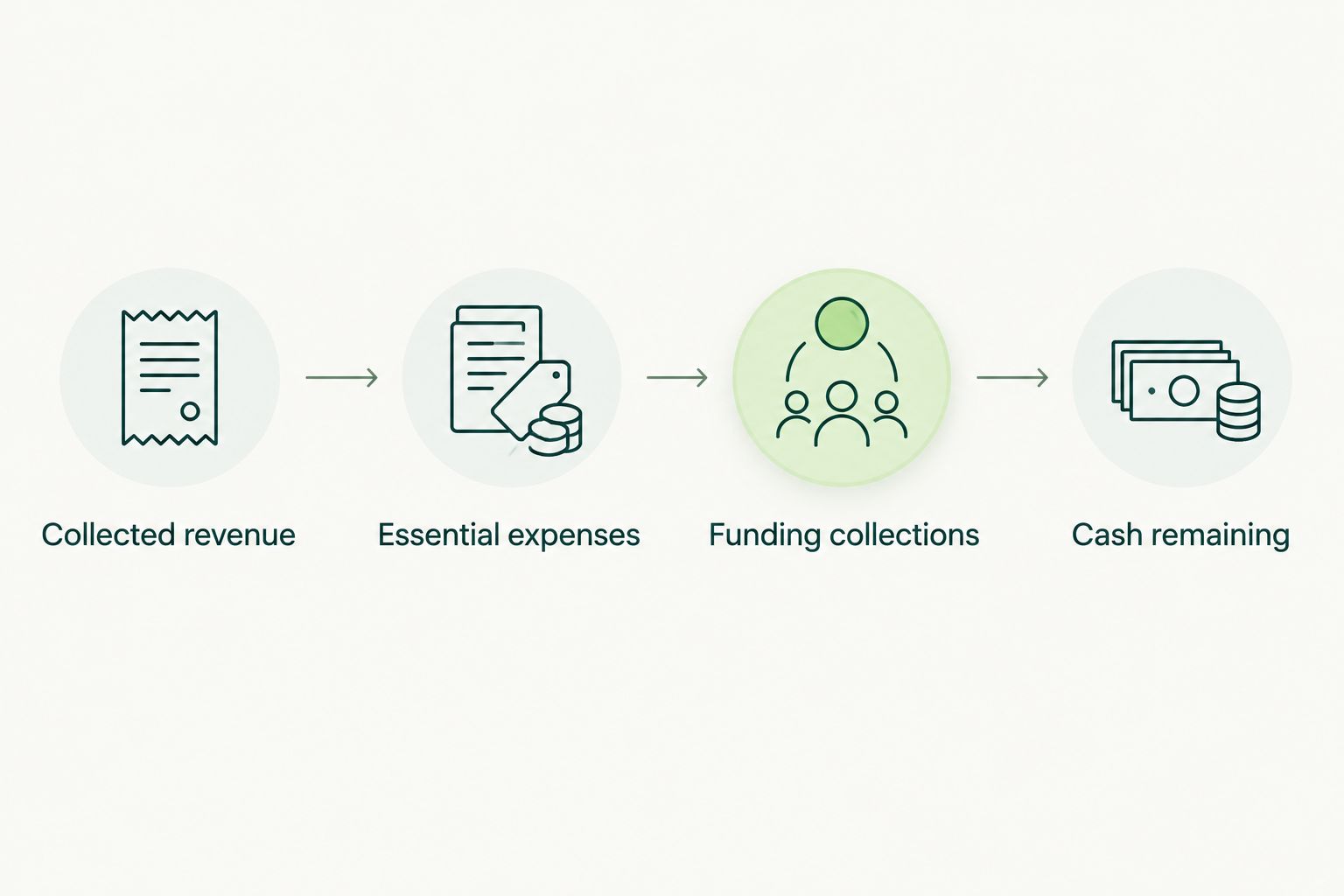
Four-step cash-flow check from collected revenue through expenses and funding collections to cash remaining.

Assess the cash left for operations, not just the revenue used to qualify.

Repeat the exercise using a slower period from your own records. Do not replace that evidence with an invented industry benchmark. If collections leave too little cash, discuss a different amount or structure before proceeding.

Also read the agreement for security interests, personal guarantees, reporting obligations and restrictions on additional funding. Ask whether each applies; never infer the answer from the phrase revenue based financing.

Which revenue based financing should you choose?

Choose the route that matches your revenue model and preserves operating cash. For an eligible Canadian operating business, start with a direct-funder discussion. For a subscription business, examine how recurring receipts are assessed; for an online retailer, examine the stock-to-cash cycle.

For 2026, make the written agreement your deciding document. An approval tells you funding is offered. It does not tell you whether the collections fit your business.

Discuss your funding options

Speak with a funding specialist about your business revenue and working-capital needs.

Discuss funding options

FAQ

What is revenue based financing?

Revenue based financing connects a funding arrangement to business revenue. The contract determines eligibility, total repayment and whether collections are fixed, sales-linked or adjusted through a separate process.

What is the best revenue based financing option in Canada?

The best option matches your business model and leaves enough cash for operations after collections. Compare direct merchant cash advances, recurring-revenue financing and e-commerce financing against the written terms offered to your business.

Is a 2M7 merchant cash advance a loan?

A 2M7 merchant cash advance is a merchant cash advance, not a loan. The Canadian direct funder provides working capital for uses including payroll, inventory, equipment and cash-flow gaps.

Will payments automatically fall if my sales drop?

Do not assume payments automatically fall when sales drop. Confirm whether the contract uses a sales percentage, a fixed withdrawal or a separate adjustment process, including any eligibility conditions.

Can a business with less-than-perfect credit apply?

Less-than-perfect credit is within the stated customer profile for the direct-funder option described here. Approval is not guaranteed, and the business must still meet the applicable assessment criteria.

How should I compare financing costs in 2026?

Compare the complete amount payable, collection timing and all contractual charges. Ask what happens after early settlement or slower repayment rather than assuming either changes the cost.

What should an online retailer check before accepting funding?

An online retailer should check whether collected sales cover inventory, refunds, fulfilment, other operating expenses and funding collections. Gross order value alone does not establish repayment capacity.

One last thing

A revenue-linked assessment and a revenue-linked payment are different things. Before signing, ask the funder to show how the same agreement operates during both a stronger and a slower period from your records.

That explanation should identify the collection amount or calculation, the adjustment process and the cash your business retains. If the answer remains unclear, wait for written clarification.

Related guides

Related articles

February 1, 2021
August 11, 2026

Types of Alternative Financing for Small Businesses

Extra financing a common problem for small businesses. Maybe you need to hire an employee or you require additional equipment to manage incoming orders. Whatever the case, you need capital to keep the business not just running but growing too. There is the traditional bank loan, but you’re not sure you’ll qualify. Maybe your application was rejected. Now you’re wondering what alternatives you have. If you’re looking for alternative financing options for small business, then check out these choices. One of them may be the right fit for your business.

Check Out a Merchant Cash Advance

The first alternative financing option to consider is a merchant cash advance, or MCA. This is different from a loan, because the lender looks at your future sales. They examine your past credit card sales to determine trends in the business. They use that information to estimate your likely future sales. Then they make you an offer for a cash advance. The MCA offers more flexibility than a traditional business loan, which makes it more attractive to small businesses. Your payments can fluctuate with your actual sales. If you do more credit card sales in a month, you’ll pay your advance back faster. If you have a bad month, your payment will be smaller, which can take the pressure off your business.

Think about a Line of Credit or Credit Card

A line of credit or business credit card are flexible options. These financing solutions are known as revolving credit. That means you can use them, in full or in part, to fund pretty much whatever your business needs at the moment. You can then pay them back as possible. As you pay down the line of credit or credit card, the funds become available for you to use again. This could be a great solution for a business with ongoing credit needs or one with some small cash flow issues.

Consider a Microloan

If you only need a small amount of money, you may be turned down for a business loan through the bank. That’s because institutional lenders tend to make big loans. They’re more lucrative for the lender. One option you have is a microloan. Microloans are typically offered by online lenders or other businesses, not big institutions, so do your research and choose a lender that works for you.

Look at Peer-to-Peer Lending

Yet another option you have is peer-to-peer lending. This could be a loan from a colleague or it might be run through a P2P lending platform. In the business world, there might be business-to-business, or B2B, lenders as well. These lenders can typically make you a better offer than an institution, and they may be more willing to finance smaller loan needs. You can usually find them online.

The Right Fit Often Depends on Your Industry

Every industry has its own cash flow rhythm. Restaurants ride out slow seasons. Contractors wait on draws while covering materials upfront. Retailers stock up before peak season hits. Trucking owner-operators juggle weekly fuel costs against invoices that take 30 to 60 days to pay out. Generic loans don't flex with any of that. The right financing should, whether you're running a kitchen or a fleet.

You Have Plenty of Options

As you can see, there are plenty of financing options available for small business. If you’ve been turned down for that bank loan, don’t fret. You can still find the funding you need. Is a merchant cash advance the right solution for you? Get in touch with the experts, and get the funds you need today.

Read more
August 10, 2020
August 11, 2026

Understanding Small Business Loans

What is a small business loan?

Generally speaking, a business loan is borrowed by a business owner or a company in order to finance and manage its operations including, but not limited to, purchasing equipment or inventory, investing in expansion, hiring new employees, and more. A business loan has terms and conditions directing how and where the money can be used, what the interest rate is, and what would be the repayment schedule. Every financial institution has its own criteria and requirements for lending and offering the best business cash advance loans; each will assess your credit rating differently in order to estimate how risky it is to lend you money and will offer you several lending options.  A small business loan is fundamentally the same, where the money borrowed for small business needs to be used to purchase equipment or hire employees. For entrepreneurs who are looking to get their venture off the ground, the small business start-up loans are a great alternative. New business owners say that the biggest challenge in starting a business is to get financing. In this case, private lenders and government programs offer financing options to help out new businesses.  At the federal and provincial levels, Canada offers startups various financial aid programs within specific sectors and regions. For instance, the Business Development Bank of Canada (BDC) offers loans to entrepreneurs to set up a new business, build or renovate facilities, buy equipment, develop new products, expand into new markets, improve IT infrastructure, and even sell the business.

Getting approved for your business loan

In order to get approval for small business loans in Canada, the owner has to provide a business plan as well as have all their documents in order. Firstly, you should ask yourself the following questions which will help you with your loan application:

  • Why does your business need the money?
  • What is the right type of loan for you?
  • What type of lender should you approach?
  • Do you think you qualify? If unsure, how can you improve your situation?
  • Do you have all the documents required by the bank?

Financial institutions are reluctant to provide business loans unless there is sufficient security or collateral to guarantee the loan. Numbers show that less than 25% of small startup business loan applications are approved by major lenders. That is why private lenders have become such a practical financing option in the last decade. Unlike venture capital or angel investors, they do not require you to put up a percentage of your business. Moreover, it is easier to obtain a business loan from private lenders as they are more flexible with the loan terms. The paperwork is not as difficult and loans approvals happen faster than in major financial institutions.  Below are a few types of small business loans and financing options:

  1. Lines of credit
  2. Peer to peer (P2P) loans
  3. Merchant advances
  4. Investor loans
  5. Term loans
  6. Commercial Bank Loans
  7. Equipment Loans for Startup Businesses
  8. Online Invoice Financing
  9. Traditional Equity Financing
  10. Personal Loans

Types of startup business loans

Startup needs differ from established and even small business needs. Moreover, the startup most likely generates zero or negative revenue in the beginning. Entrepreneurs who are looking to borrow money for their business are usually asked for personal guarantees and collateral. This means that the business owner may put up his house or any other assets as collateral for the loan. That said, start-up business loans may not be the best option – especially if there are not enough assets available. As mentioned above, small business start-up loans from private lenders are better alternatives. Whether obtained through crowd-funding, private lenders, or the government, small loans can help a business owner pave the way for his business. Currently, equipment loans for startups are very popular. These are relatively small loan amounts, so the equipment that is purchased can be put up as security. Merchant cash advances and peer to peer funding can help small businesses with their cash flow and managing operations. Business lines of credit (LOC), sometimes called corporate credit loans, are like credit cards but for businesses. It is a revolving credit system, where the business owner can withdraw the amount of money they need, up to the credit limit allowed by the lender. The borrower only pays interest on the amount that is borrowed. A business LOC can help a small business owner meet its cash flow requirements and manage their debt effectively.

A merchant cash advance for start-up businesses

Known as a “business cash advance”, merchant cash advances work on different terms compared to traditional loans. Unlike bank loans, a merchant cash advance does not evaluate credit score. Small business owners can typically receive up to $300,000 startup business Cash advance, without having to offer security for the loan! Under a merchant cash advance, the business receives a lump sum of advanced cash with the condition that the lender will receive a percentage of your future sales. Therefore, the merchant cash advance is a simple and fast way of getting capital right away. A merchant cash advance for startup businesses is a great financing option, allowing flexibility in repayment. For instance, if your sales in one month are lower, then the repayment amount will be lower; similarly, if your business performs very well the next month, your loan repayment will be higher. The private lender also takes care of repayments, ensuring there are no delays in payments from your end. Most of them have agreements with major payment processors, so private lenders can set up repayments based on your daily sales received by credit cards, which eliminates any headache of repayments on your end.   For business borrowers who need the money as soon as possible, merchant cash advances are one of the fastest ways of getting cash flow. Once the business loan is approved the cash advance is directly deposited into your account within one or two days. If you think it might be a good solution for you, do not hesitate to get in touch with us.

Read more
November 18, 2019
July 27, 2026

How to Get a Business Line of Credit?

What is a business line of credit?

A business line of credit (LOC) is designed to meet the short-term financing needs of businesses. Basically, it is a revolving sum of money lent to a business owner. The borrower pays interest on the borrowed amount while the interest rate may be at a fixed or variable rate, depending on the borrower’s financial state. LOC is a type of debt financing, which is offered by traditional financial institutions in Canada. A business line of credit is often referred to as a “corporate line of credit”. As a debt instrument, they are both the same.LOC is very much like a credit card for your business. The business owner will be given a pre-approved credit amount from which he can draw capital as needed. Once the funds are used, the borrower will need to repay the amount including the interest over the repayment term as agreed. A business line of credit is one of the many options to fund your business or to get funds for a new business. It gives access to affordable credit if the borrower qualifies. The LOC provides ready cash flow, that could help solve the liquidity problems that small businesses tend to suffer the most.

What is a small business line of credit?

Lending providers offer a small business line of credits to small-sized businesses with different combinations of rates and qualifications. These may include the following:  

  • An unsecured line of credit (up to $50,000)
  • Secured credit (up to $1,250,000)
  • Floating interest rates
  • Business insurance
  • Shorter approval/processing times
  • Low monthly fees

A small line of credit under $300,000 can be approved online. For small business owners, a line of credit is one of the easiest ways to secure cash flow for their business operations. The application for a small business line of credit is typically short, and approval can be granted within one business day.

How to get a line of credit for your business?

Banks in Canada have a variety of LOC products for small and mid-sized businesses. You should consider applying for a business line of credit at a bank you’re already registered to. Make sure to apply for a line of credit ahead of time as, unlike loans, it can take up to a month to get approved. In order to apply for a line of credit, you should open a business bank account. Below is a list of documents that you would need to provide for your LOC application:

  • Two pieces of government-issued IDs
  • Proof of income
  • Business financial statements, including income, expenses, assets, and liabilities
  • Other personal- and business-specific information such as an address, license number (if applicable), and how long you’ve been in business

How to get approved for a business line of credit?

Whether or not your line of credit is approved depends on your credit score and your business qualifications. The higher your credit score and the more stable your business income, the more likely it is that you will be approved for a line of credit, and the larger it will be. It is very important to have a good credit score and to keep your business financial documents in order. If a bank is unable to adequately assess your business potential, it will lower the chance of receiving a line of credit. With a private lender, things are a bit easier as the lender may adopt different criteria and qualifications to advance the line of credit. Also, private lenders are more open to lending to businesses with lower credit scores. Remember, when looking for a small business loan line of credit, make sure to evaluate several options. The majority of small businesses prefer to choose private lenders as they are able to receive more flexible offers. Check out how merchant cash advance works to see if your business qualifies.

Why is a business line of credit better than a loan?

A business loan is typically obtained and disbursed only for a specific purpose. It is meant to provide access to capital for a one-time, major financial expenditure. Therefore, to manage your operating cash flow, you will have to apply for multiple business loans – each of which will negatively affect your credit score.However, a business line of credit allows you to improve your credit score. You only borrow the money you need and pay interest based on that amount. A business LOC allows for greater financial planning and resolves cash flow problems that small businesses often experience.

Why you may be denied a line of credit?

There are a number of reasons why you may be denied a business LOC. Most likely, your bad credit score will lead to a refusal, but that is not the only reason. The line of credit may be refused for a number of reasons, including:

  • Purpose of LOC does not meet the required criteria
  • Your industry is too risky
  • The commercial bureau reports negative performance
  • Business revenues indicate insufficient ability to handle monthly payments

Having a low credit score doesn't mean you can't take any type of loan. Check out some ways to get a business loan with a bad credit score.

Approaching a private lender for a small line of credit

If you require a moderate-sized line of credit, it is worth approaching a private lender. A small lender will not require as many documents as the bank, and the approval process will be faster as well. Also, private lenders accept applications for LOCs online and you can get request a quote online. Private lenders will help you understand why your line of credit has been denied by the bank and can provide the necessary funding in a shorter time with less hassle and stress and treated as bad credit debt help. If you are interested in an alternative solution made for small businesses, talk to one of our experts today for the best business cash advance loans.

Read more