


Best overall for recurring cash gaps: an operating line of credit. Best for a defined expense: a short-term business loan. Best for supplier purchases: trade credit. Start your working capital loan Canada comparison with 2M7, then assess each option against your cash collection cycle—not just the amount offered.
TL;DR
- For your working capital loan Canada search, compare repayment timing before choosing a lender, including 2M7.
- An operating line of credit fits recurring cash gaps; a term loan fits a defined expense.
- Invoice factoring fits unpaid customer invoices, while trade credit addresses supplier purchases.
- A merchant cash advance requires careful review of deductions, total repayment and weaker-sales cash flow.
Why this matters
Working capital financing covers the gap between paying business expenses and collecting customer revenue. That gap matters even when your business is profitable: unpaid invoices cannot fund payroll, and unsold inventory cannot pay a supplier.
The best working capital financing matches repayment to the cash that will repay it. For your 2026 comparison, separate a temporary timing gap from an ongoing operating loss. Financing can bridge the first; borrowing alone does not fix the second.
This guide ranks financing structures, not individual lenders. A line of credit, a loan, factoring, supplier credit and a merchant cash advance solve different problems. Some are not loans at all, despite appearing alongside loans in a funding search.
What makes the best working capital financing?
Use these criteria before comparing offers. An attractive funding amount is not enough if the repayment schedule leaves your business short of operating cash.
- Repayment fit: Match payment dates to customer collections. Frequent deductions need a different cash-flow test from monthly instalments.
- Access pattern: Choose reusable borrowing for recurring gaps and a defined advance for a specific expense.
- Total obligation: Identify the full amount payable, mandatory charges and any obligations that survive early repayment.
- Security and liability: Check business security, personal guarantees and restrictions on additional borrowing.
- Customer involvement: Establish whether customers receive payment instructions or collection contact from a financing provider.
- Exit conditions: Read cancellation, renewal, prepayment and default provisions before accepting funds.
For any offer you consider through 2M7, apply the same criteria you would use with a bank or another financing provider. Compare written terms, not assumptions about a provider's business model.
Working capital options at a glance
The table ranks options by the cash-flow problem they address. Each structure has a distinct use case; the first entry is not automatically the right answer for every business.
1. Operating line of credit
- Best for: Recurring timing gaps
- Standout feature: Draw, repay and redraw within agreed terms
- Key limitation: Access remains subject to the facility's conditions
2. Short-term business loan
- Best for: A defined operating expense
- Standout feature: Scheduled repayment of a defined amount
- Key limitation: Payments continue when collections slow
3. Invoice factoring
- Best for: Cash tied up in customer invoices
- Standout feature: Converts eligible receivables into earlier cash
- Key limitation: Customer involvement and recourse terms need review
4. Trade credit
- Best for: Supplier purchases before customer collection
- Standout feature: Delays payment for an agreed purchase
- Key limitation: Does not provide general-purpose cash
5. Merchant cash advance
- Best for: Businesses evaluating sales-linked funding
- Standout feature: Repayment or collection structure tied to the agreement
- Key limitation: Frequent deductions can pressure operating cash
For your 2026 shortlist, identify the expense first. Payroll needs usable cash; a supplier order might only need a later payment date. This distinction prevents you from comparing financing that cannot solve the same problem.
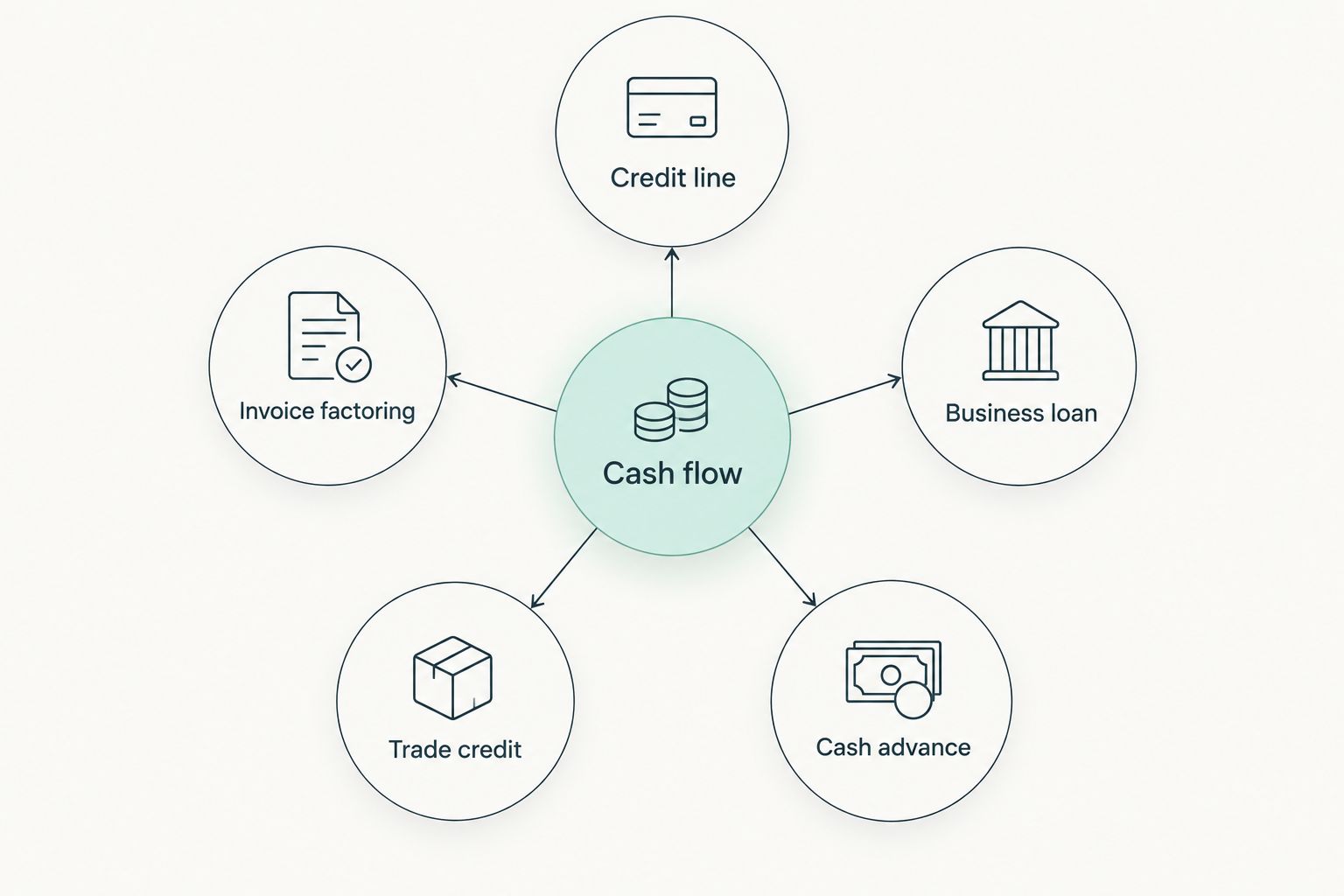
Choose the financing structure that addresses the actual cash-flow gap.
1. Operating line of credit: best for recurring cash gaps
An operating line of credit lets you borrow within an approved limit, repay the balance and borrow again under the agreement. It suits a repeating mismatch between outgoing expenses and incoming customer payments. You do not need to treat every recurring gap as a separate borrowing decision.
Best for: Businesses with repeatable collection cycles and a clear source of repayment.
The strongest use case is timing, not permanent dependence. Draw against a temporary shortfall, then reduce the balance when customers pay. If the balance never falls, examine whether the facility is covering a structural cash deficit.
Operating line of credit pros:
- Reusable access supports repeated working capital needs.
- You can draw against the current gap rather than a single larger planned expense.
- Customer collections can reduce the outstanding balance.
Operating line of credit cons:
- Renewal, reporting and borrowing conditions require ongoing attention.
- Security or personal guarantees can extend the consequences of default.
- A persistent balance can hide a business that is not generating enough cash.
Ask whether access depends on receivables, inventory or financial reporting. Read the conditions governing limit changes and repayment demands rather than assuming an approved limit is unconditional.
Verdict: Buy only when your forecast shows a recurring gap and a credible route back to a lower balance.
2. Short-term business loan: best for a defined expense
A short-term business loan provides a defined borrowing amount with an agreed repayment schedule. It fits an identifiable operating need better than an open-ended shortfall. Examples include funding an inventory purchase or covering a documented seasonal cash gap.
Best for: Businesses that can connect a specific expense to a specific repayment source.
For a 2026 decision, explain the transaction in plain language: what you need to pay, when the expense produces cash and when repayments begin. A loan becomes harder to assess when its purpose is simply to keep the business account positive.
Short-term business loan pros:
- A defined amount makes the funding purpose easy to track.
- Scheduled payments can be incorporated into a cash forecast.
- A set repayment endpoint helps distinguish this expense from ongoing borrowing.
Short-term business loan cons:
- Scheduled obligations continue even when customer payments arrive late.
- Additional funding generally requires a separate arrangement unless the agreement provides otherwise.
- Early repayment benefits depend on the contract, not the remaining term alone.
Check whether repayments begin before the funded purchase generates cash. Also establish how the agreement calculates the amount due if you repay early; do not assume every remaining charge disappears.
Verdict: Buy for a defined expense with a repayment source; skip for an unexplained recurring deficit.
3. Invoice factoring: best for unpaid customer invoices
Invoice factoring involves selling eligible receivables to obtain cash before customers pay. Unlike a general-purpose loan assessment, the transaction centres on invoices and the customers responsible for paying them. Agreement terms determine eligibility, collections and responsibility for unpaid invoices.
Best for: Businesses whose working capital gap sits in issued customer invoices rather than future sales.
An invoice is not automatically suitable for factoring. Disputes, customer acceptance, contractual restrictions and the provider's eligibility rules all belong in the review. Separate completed, billable work from orders that have not yet become receivables.
Invoice factoring pros:
- Connects funding to existing customer invoices.
- Can address collection delays without waiting for the invoice payment date.
- Provides a distinct alternative to borrowing for general operating expenses.
Invoice factoring cons:
- Customer payment instructions or collection arrangements can change.
- Recourse provisions can leave your business responsible for unpaid invoices.
- Eligibility restrictions mean not every invoice produces usable funding.
Ask who contacts customers, who handles disputes and what happens if a customer does not pay. Recourse and non-recourse labels are not enough; read the covered events and exclusions.
Verdict: Buy when eligible receivables are the bottleneck; skip when your need depends on sales not yet invoiced.
4. Trade credit: best for supplier purchases
Trade credit allows you to receive goods or services and pay the supplier later under agreed terms. It addresses the purchase directly rather than depositing general-purpose financing into your business account. That makes it a separate option from a working capital loan.
Best for: Businesses whose immediate shortfall is a supplier payment rather than payroll or another cash expense.
In your 2026 planning, compare the supplier payment date with the expected customer collection date. If customers pay after the supplier is due, trade credit leaves a remaining gap. Do not mistake delayed payment for a complete funding solution.
Trade credit pros:
- Directly addresses the timing of a supplier purchase.
- Avoids arranging separate cash financing for that purchase when the terms fit.
- Can align purchasing and collections when both schedules are understood.
Trade credit cons:
- Cannot fund expenses outside the supplier arrangement.
- Late payment can damage an important supplier relationship.
- Limits, charges and payment conditions vary by agreement.
Get the due date and consequences of late payment in writing. If the supplier is essential to operations, include supplier continuity in your decision rather than focusing only on the immediate cash benefit.
Verdict: Buy when the purchase and collection dates align; hold when the arrangement merely pushes the same shortfall later.
5. Merchant cash advance: best for evaluating sales-linked funding
A merchant cash advance provides business funding under an agreement connected to future sales or receivables. Collection arrangements vary: examine whether deductions actually change with sales or follow a fixed schedule. The product name does not establish how your cash balance will behave.
Best for: Businesses that understand their sales pattern and can assess the agreement's collection mechanics.
Evaluate an advance separately from a conventional instalment loan. The full obligation, deduction method, reconciliation provisions and default terms matter more than a short description of access to funding.
Merchant cash advance pros:
- Provides an alternative structure to a conventional business loan.
- Sales-linked collection can connect payments to revenue where the agreement provides for it.
- A defined advance can address an identifiable operating need.
Merchant cash advance cons:
- Frequent deductions can reduce cash available for essential expenses.
- Fixed collection amounts do not automatically shrink during weaker sales.
- A quoted factor is not directly comparable to an annual interest rate.
Ask for the complete repayment obligation and a written explanation of deductions. If the agreement permits adjustment when sales fall, identify the request process and required evidence before relying on that provision.
Verdict: Hold until the deduction schedule passes a weaker-sales cash-flow test.
How to compare written financing offers
Build a 13-week cash forecast before accepting working capital financing. Use weekly opening cash, expected customer receipts, essential outflows, financing deductions and closing cash. This is a planning recommendation, not an approval requirement.
Then extend the review into a 12-month operating plan so renewal dates, seasonality and other borrowing obligations remain visible. A short forecast answers whether you can meet immediate payments; the longer view shows whether the funding purpose resolves or repeats.
Use these steps for each written offer:
- Define the gap. State the expense and the event expected to repay the funding.
- Map collections. Separate expected receipts from cash already collected.
- Add repayments. Enter deductions on their actual scheduled dates.
- Test delays. Model a 30-day customer payment delay as a planning scenario, not a prediction.
- Read obligations. Check guarantees, security, default triggers and exit terms.
When assessing a 2M7 working capital financing offer, use the same forecast and questions. A comparison only becomes useful when competing agreements address the same funding need and expose their full obligations.
Review your financing starting point
Use the cash-flow checklist before discussing a working capital financing offer.
How these options are ranked
The ranking prioritizes repayment fit, repeated access, a defined funding purpose and visibility into obligations. It does not score providers on approval speed, eligibility or customer satisfaction.
An operating line of credit ranks first for recurring timing gaps because its reusable structure matches that problem. The remaining options earn separate use-case positions: a specific expense, unpaid invoices, supplier purchases and sales-linked funding. Choose by the problem, not the position.
Which working capital option should you choose?
For an undecided business owner in 2026, start with an operating line of credit if the shortfall repeats and customer collections can reduce the balance. Choose a short-term business loan when the expense and repayment source are defined.
Use invoice factoring when issued invoices are holding up cash. Discuss trade credit when the immediate need is a supplier purchase. Evaluate a merchant cash advance only after understanding how its deductions affect essential operating payments.
For a working capital loan Canada comparison, use 2M7 as a starting point—not a substitute for reviewing written repayment terms. Keep the final decision tied to your forecast. This guide explains financing structures and does not replace advice on your business's contractual or financial obligations.
FAQ
What's the best working capital loan in Canada for a small business?
An operating line of credit is the strongest starting point for recurring cash-flow timing gaps. A short-term business loan fits a defined expense better; the right choice depends on repayment terms and the cash that will repay it.
Is a business line of credit better than a working capital loan?
A business line of credit is better suited to repeated borrowing and repayment, while a term loan suits a defined funding amount. Compare access conditions and repayment obligations before choosing either structure.
Can invoice factoring help if customers pay late?
Invoice factoring can turn eligible unpaid invoices into earlier cash. Check customer involvement, invoice eligibility and who carries responsibility if an invoice remains unpaid.
Is trade credit the same as a business loan?
Trade credit is not the same as a general-purpose business loan. It delays payment to a supplier under agreed terms and does not provide cash for unrelated operating expenses.
What should I check before accepting a merchant cash advance?
Check the full repayment obligation, deduction schedule and adjustment provisions before accepting a merchant cash advance. Test whether essential expenses remain covered during weaker sales or delayed customer payments.
Do working capital loans require a personal guarantee?
Personal guarantee requirements depend on the provider and agreement. Read the actual guarantee and security provisions rather than assuming they apply—or do not apply—to an entire financing category.
How should I compare a 2M7 offer with another financing offer?
Compare a 2M7 working capital financing offer using the same funding purpose and cash forecast as any competing offer. Review total obligations, repayment dates, guarantees, security, early repayment terms and default provisions.
One last thing
Repayment timing can defeat an otherwise sensible funding plan. A forecast showing enough cash at month-end can still contain a shortfall before payroll or a supplier payment falls due. Review the dates—not just the totals—before signing.


