ClickCease

Best equipment financing for healthcare and dental practices 2026

Best equipment financing for healthcare and dental practices 2026

Best equipment financing for healthcare and dental practices 2026
19
Oct 2026
19
Oct 2026

Best overall: a dedicated equipment loan for a planned, long-term purchase. Best for scheduled upgrades: equipment leasing. Best for equipment plus operating expenses: 2M7 merchant cash advance funding. This 2026 guide compares equipment financing for healthcare practices by ownership, payment structure and fit for your cash flow.

TL;DR

  • Dedicated equipment loans are the default equipment financing for healthcare practices buying assets for long-term use.
  • Equipment leasing suits dental and healthcare practices that want an agreed equipment replacement or return path.
  • 2M7 merchant cash advance funding suits equipment purchases combined with payroll, inventory or other working capital needs.
  • Compare total repayment, ownership terms and payment obligations before choosing funding.

Why this matters

A dental chair and the payroll needed to operate a practice are different funding needs. An equipment agreement addresses the asset; working capital addresses the business around it. Bundling both into the wrong agreement makes comparison harder.

For a 2026 purchase, start with the equipment's expected useful life and the practice's available cash. Then compare financing structures. A lower scheduled payment does not establish a lower total cost, and equipment delivery does not necessarily mean the equipment is ready to generate revenue.

Choose the funding structure before choosing the provider. That keeps ownership, payment obligations and installation expenses in the same decision.

What makes the best equipment financing for healthcare practices

Use these criteria to compare written offers for medical, dental and other practice equipment:

  • Ownership: Establish who owns the equipment during the agreement and what happens at the end.
  • Useful life: Match the funding period to how long you expect to use the asset, not just the payment you prefer.
  • Total obligation: Compare the full amount payable, including required fees and any end-of-term purchase obligation.
  • Cash flow fit: Check payment frequency against patient collections, insurer payments and other operating commitments.
  • Funding scope: Confirm whether the agreement covers equipment alone or also delivery, installation, training and operating expenses.
  • Exit terms: Read early settlement, equipment return, replacement and security provisions before signing.

For your 2026 shortlist, request these details in writing. An equipment quotation and a financing quotation answer different questions; you need both to judge the purchase.

Equipment financing options at a glance

The ranking below reflects a planned equipment purchase as the default situation. Each alternative serves a different need rather than claiming to be the cheapest for every practice.

Dedicated equipment loan

  • Best for: Planned purchases for long-term ownership
  • Standout feature: Borrowing tied to an equipment purchase
  • Key limitation: Security, guarantees and eligible expenses depend on the agreement

Equipment lease

  • Best for: Planned replacement or return
  • Standout feature: Contract defines equipment use and end-of-term choices
  • Key limitation: Ownership and exit rights are not automatic

2M7 merchant cash advance

  • Best for: Equipment plus working capital
  • Standout feature: Direct funding for equipment and operating needs
  • Key limitation: Existing business and revenue requirements apply

Business line of credit

  • Best for: Smaller purchases made in stages
  • Standout feature: Draw funding as eligible expenses arise
  • Key limitation: Access remains subject to the facility's terms and limit

1. Dedicated equipment loan: best for long-term ownership

A dedicated equipment loan finances an equipment purchase through a lending agreement. It is the strongest starting point when you know the asset, intend to keep it and can support scheduled payments from practice cash flow.

For a dental practice buying a chair or a healthcare practice buying diagnostic equipment, ownership matters beyond delivery. Check whether the lender takes security over the equipment, other business assets or both, and whether a personal guarantee is required.

Equipment loan pros

  • Supports a purchase intended for long-term use.
  • Separates a major capital purchase from routine operating spending.
  • Lets you compare a defined borrowing amount and repayment schedule.
  • Provides a clear basis for comparing purchase funding against leasing.

Equipment loan cons

  • Required security and guarantees can extend beyond the equipment itself.
  • Installation, training or related expenses need explicit approval for inclusion.
  • Selling or replacing financed equipment can require the lender's consent.

Best for: Established practices purchasing equipment they expect to keep rather than replace on a short cycle.

Ask the lender how it handles used equipment, supplier deposits and delivery delays. Do not assume approval for the machine also covers renovations or the period before it becomes operational.

Verdict: Buy with a dedicated equipment loan when long-term ownership is the priority and the complete repayment schedule fits your practice.

2. Equipment leasing: best for planned replacement

Equipment leasing gives your practice the right to use equipment under a contract. The agreement determines payments, responsibilities and what you can do when the term ends.

A lease deserves a place on your shortlist when you expect to replace equipment as practice requirements change. It is not automatically a subscription with a simple return process: purchase options, renewal provisions and return conditions must appear in the contract.

Equipment lease pros

  • Makes equipment use, rather than immediate ownership, the starting point.
  • Can support a planned replacement cycle when the contract provides for it.
  • Defines end-of-term choices before you commit.
  • Creates an alternative to borrowing for an outright purchase.

Equipment lease cons

  • Payments do not automatically give your practice ownership.
  • Early termination and equipment returns can create additional obligations.
  • Maintenance, insurance and servicing are not automatically included.

Best for: Dental and healthcare practices with a clear replacement plan and acceptable contractual return or purchase terms.

Before choosing a lease in 2026, ask what happens if the equipment stops meeting your clinical needs before the term ends. Also confirm who handles removal, shipping and any required restoration when you return it.

Verdict: Buy through leasing when the replacement plan is clear; skip a lease whose exit conditions you cannot accept.

3. 2M7 merchant cash advance: best for mixed funding needs

A merchant cash advance provides business funding rather than an equipment loan. This route fits a different problem: your practice needs equipment and working capital for expenses such as payroll, inventory or a cash flow gap.

2M7 is a Canadian direct funder, not a broker. It serves businesses operating for at least 3 months with $15,000 or more in monthly revenue, including businesses with less-than-perfect credit.

Merchant cash advance pros

  • Supports equipment and working capital needs through the same funding category.
  • Provides a direct relationship with the funder rather than a broker.
  • Includes consideration for businesses with less-than-perfect credit.
  • Uses one fixed cost of capital, disclosed before signing, that does not change with repayment duration.

Merchant cash advance cons

  • Minimum operating history and monthly revenue requirements apply.
  • A fixed cost of capital does not become lower simply because repayment takes less time.
  • Flex payments are only for businesses processing daily card payments.

Best for: Operating practices that need equipment funding alongside payroll, inventory or other working capital, rather than asset-only financing.

The published 75% approval rate is not an individual approval decision. Confirm your practice's eligibility, the proposed payment structure and the full obligation before treating funding as committed.

For healthcare practices paid through a mix of insurer reimbursements, patient payments and other sources, discuss that collection pattern directly. Do not assume a payment feature designed for daily card processing applies to your practice.

Verdict: Buy through merchant cash advance funding when the need spans equipment and operating expenses and the written payment terms fit your collections.

4. Business line of credit: best for staged smaller purchases

A business line of credit provides access to borrowing up to an approved limit, subject to its terms. It suits purchases made at different times rather than a single large asset acquisition.

For example, a practice adding equipment room by room can compare a credit facility with separate purchase agreements. The important distinction is access versus commitment: an available limit is not a reason to spend it all.

Business line of credit pros

  • Supports borrowing as individual eligible expenses arise.
  • Helps separate purchase timing from a single equipment delivery date.
  • Can address incidental business expenses as well as equipment, subject to permitted use.
  • Lets you reserve borrowing for actual purchases rather than estimated future needs.

Business line of credit cons

  • Equipment purchases consume capacity that might otherwise cover operating needs.
  • Rates, payment requirements and review conditions depend on the agreement.
  • A revolving balance needs a deliberate repayment plan.

Best for: Practices making smaller, staged purchases while preserving a defined reserve for day-to-day operations.

Set a repayment target for each equipment purchase before drawing funds. Otherwise, a long-lived asset can sit inside a revolving balance without a clear point at which the purchase is paid off.

Verdict: Buy through a line of credit for staged purchases; skip it when the purchase would absorb the practice's operating reserve.

Compare written offers in the same order

You cannot compare an equipment lease with working capital funding by looking at the scheduled payment alone. Put each offer against the same purchase plan and include the obligations that sit outside the headline payment.

Purchase scope

List the equipment, delivery, installation, training and any site work separately. Mark which expenses each agreement actually covers. Confirm when suppliers require payment and when the practice becomes responsible for financing payments.

Total obligation

Request the full amount payable and the payment schedule. For a lease, include any required purchase payment if ownership is your goal. For other funding, confirm fees, early settlement conditions and security requirements.

Collection fit

Map the proposed payment dates against collections and existing commitments. Include payroll, rent and supplier payments. A purchase that fits annual revenue can still place pressure on cash between collection dates.

Exit terms

Ask what happens if you replace the equipment, sell the practice or settle the agreement early. Get written answers. A verbal explanation does not replace the signed terms.
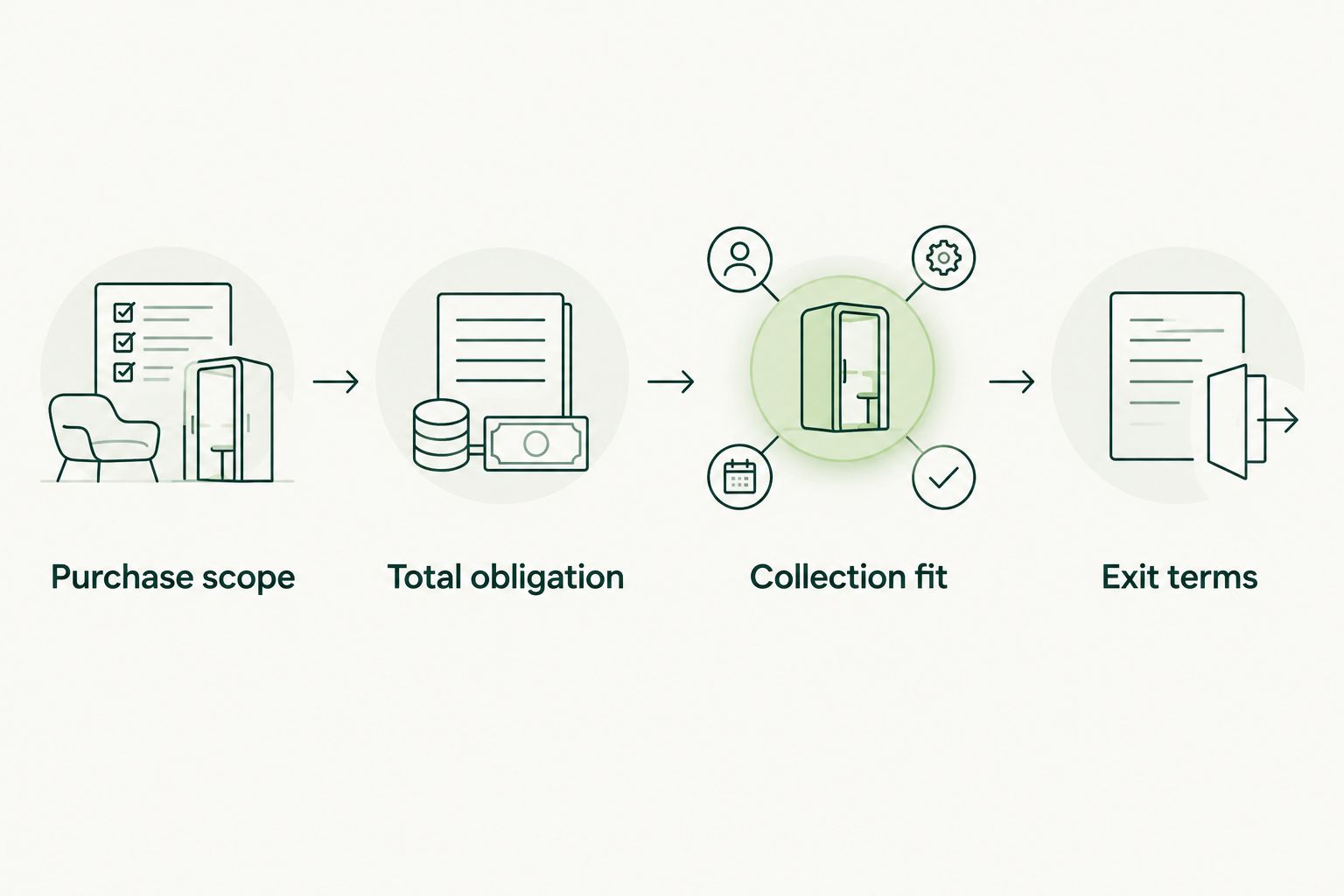
Four checks for equipment funding: purchase scope, total obligation, collection fit and exit terms.

Compare the complete obligation and collection schedule, not just the scheduled payment.

How the options are ranked

This 2026 ranking puts a dedicated equipment loan first because the default task is purchasing equipment for continued use. Leasing takes the replacement-planning slot, merchant cash advance funding addresses mixed equipment and operating needs, and a line of credit addresses staged purchases.

The ranking uses ownership, useful life, total obligation, cash flow fit, funding scope and exit terms. It is a comparison of funding structures, not a provider scorecard or a claim that one agreement has the lowest cost.

Which equipment financing should you choose?

Start with a dedicated equipment loan for a defined purchase you intend to keep. Compare a lease alongside it when replacement or return is part of your plan, not simply because its scheduled payment looks smaller.

Choose 2M7 equipment funding when the purchase forms part of a broader working capital need and a merchant cash advance fits your practice's collections. Keep a line of credit focused on staged purchases that leave enough capacity for operating needs.

For a 2026 decision, the final test is practical: can you explain the complete payment obligation, ownership position and exit terms without relying on the sales presentation? If not, hold the decision until those points are clear.

FAQ

What's the best equipment financing for healthcare practices?

A dedicated equipment loan is the default starting point for a planned purchase intended for long-term use. Compare leasing for planned replacement, merchant cash advance funding for mixed operating needs, and a line of credit for staged purchases.

Is leasing better than buying equipment for a dental practice?

Leasing is a better fit when the agreement supports your intended replacement or return plan. Buying is the stronger starting point when long-term ownership matters; compare the complete obligations rather than scheduled payments alone.

Does 2M7 offer equipment loans to healthcare practices?

2M7 provides merchant cash advances and working capital, not equipment loans. Equipment is an eligible funding use, and a practice must meet the funder's business and revenue requirements.

Can a newer healthcare practice apply for merchant cash advance funding?

The stated entry requirements include at least 3 months in business and $15,000 or more in monthly revenue. Meeting those thresholds does not establish an individual approval decision or funding amount.

Can equipment financing cover installation and training?

Installation and training are covered only when the agreement includes them. Ask for an itemised list of eligible expenses before committing to equipment or supplier deposits.

What should a dental practice compare besides the payment amount?

Compare the full amount payable, payment frequency, ownership, security requirements and exit terms. Include maintenance obligations and any end-of-term purchase or return requirements.

Are flex payments suitable for every healthcare practice?

Flex payments are only for businesses that process daily card payments. A practice should confirm eligibility based on its actual collections rather than assuming all patient or insurer receipts qualify.

One last thing

Check the gap between equipment delivery and equipment use. Installation, training or site preparation can separate those dates, while payment obligations follow the agreement. Put both dates on your purchase plan before signing, then confirm which expenses your funding covers during that gap.

Related guides

Related articles

November 11, 2020
September 27, 2026

Why Businesses Should Choose Merchant Cash and Working Capital Loan

The business world has been turned upside down in the last few months, which has led to many questions for business owners. One of the most pressing has been about finances. In the current global climate, you may wonder what options you have to keep cash flowing. As it turns out, you have quite a few choices. The question is more about which options will work best for your business. There are quite a few reasons merchant cash advance and working capital loan could be the right fit.

What is Merchant Cash and Working Capital Loan?

‍Merchant cash and working capital loan refers to business financing options available to merchants on the basis of their future sales. It includes tools like merchant cash advances.A merchant cash advance, for example, is estimated on your future sales. The lender offers you cash to help you keep the business operating by estimating what your future sales are likely to be. Unlike a business loan, this option can be quite flexible as a result.

Why Choose Merchant Cash and Working Capital Loan?

‍Why are options like merchant cash advances so popular? One reason is that they provided the flexibility small businesses need.Since the advance is estimated on future sales, you pay the advance as you earn those sales. That means your payment can vary. If you have high sales, you can pay the advance down faster. If your sales are low, you won’t have to struggle to meet a high payment.The amount of the advance can also be variable. It’s also a great option for businesses that need ongoing cash injections. It also works for newer businesses or businesses that need smaller loan amounts.If any of this sounds like your business, then it could be time to discover what a merchant cash advance can do for you. Get in touch and find out if this option fits your business’s needs.

Read more
September 16, 2026
September 30, 2026

Recession-Proofing Your Small Business: A Practical Canadian Owner's Checklist

Every small business owner in Canada has felt the same low hum of anxiety this year. Interest rates aren't moving much, but that stability hasn't translated into comfort. Tariff threats keep resurfacing, input costs stay stubborn, and customers are watching their own budgets more closely than they did two years ago. If you run a restaurant, a construction firm, a trucking operation, or a retail shop, you already know this isn't hypothetical. It shows up in your margins every month.

The good news is that recession-proofing doesn't mean overhauling your business or living in a defensive crouch. It means building habits and structures now that protect you later. Below is a practical checklist built for owners who want to stay sharp rather than panic.

‍

Understand the Economic Backdrop You're Operating In

The Bank of Canada has held its policy rate steady through multiple announcements this year, most recently keeping it at 2.25 percent. That stability is worth something. Borrowing costs aren't the wildcard they were during the rapid hikes of a few years ago. But a stable rate environment doesn't cancel out the other pressures on your business, particularly trade uncertainty and cost inflation tied to tariffs.  

According to the Bank of Canada, the current hold reflects a balancing act between contained inflation and ongoing risks from trade tensions and geopolitical instability. That's a polite way of saying the central bank doesn't have full clarity on where things go next. Neither do you, and that's fine. Planning for uncertainty is a different skill than predicting it.

‍

‍

Audit Your Cost Structure

Most owners review costs reactively, after a bad quarter forces the issue. Flip that. Go through every recurring expense line by line while things are still manageable: suppliers, software, insurance, lease terms, payroll structure. Ask which of these scale with revenue and which are fixed regardless of how slow a month gets.

If you're in construction, material costs tied to cross-border supply chains deserve scrutiny right now. If you're in trucking, fuel and equipment maintenance are your biggest levers. Retail and restaurant owners should look hard at supplier contracts and whether volume discounts still make sense given current sales. This isn't about slashing everything. It's about knowing your numbers cold so you're not surprised later.

‍

Close the Legal and Insurance Gaps

Downturns expose weak spots you could ignore in good times. Have someone with legal experience, in-house or outsourced, review your contracts and lease so you're protected if a dispute hits during a slow stretch. Then check your insurance, including general liability, cyber, and home-based business coverage where they apply. One uninsured incident can sink a business that was otherwise handling a slowdown fine.

‍

Build a Cash Buffer That Reflects Your Risk

The old advice of "three to six months of expenses" is a reasonable start, but it's generic. A seasonal restaurant and a steady B2B contractor don't carry the same risk profile, so they shouldn't carry the same buffer target. Look at your slowest historical quarter and work backward: what would it take to cover payroll, rent, and core supplier payments through your worst realistic stretch without touching credit.

Building this buffer is slow work, and most owners don't get there through savings discipline alone. That's where financing tools come in, not as a crutch but as a deliberate part of the plan.

‍

Know Your Financing Options

This is the mistake that sinks otherwise solid businesses: waiting until cash is already tight to start exploring funding. By then, your options are worse, your terms are worse, and your negotiating position is worse. The smart move is understanding your options while your business is still healthy.

‍

Match the Tool to the Situation

Small business loans remain a standard tool for owners with strong credit and predictable revenue, but traditional lending isn't accessible to everyone, and it isn't always fast enough. A merchant cash advance, structured against future receivables rather than a fixed repayment schedule, can bridge a gap in weeks rather than months. For businesses with bad credit or thin banking history, alternative lenders often evaluate cash flow rather than relying solely on credit scores, opening doors that traditional banks keep closed.

Fast business funding matters most when opportunity or emergency doesn't wait for a six-week approval process. A restaurant that needs to replace a broken walk-in cooler before a weekend rush, or a contractor covering payroll while waiting on a delayed client payment, doesn't have the luxury of a slow process. Knowing which lender and product fits your situation before you're desperate is what separates owners who navigate a rough patch from owners who get sunk by one.

‍

Watch the Data, Not Just the Headlines

Headlines about tariffs and rate decisions tend toward drama. The actual data is more useful. According to Statistics Canada, roughly a third of Canadian businesses expect U.S. tariffs to hurt them over the next year, and more than a quarter have already passed cost increases on to customers. That's not a crisis signal, it's a planning signal: pricing adjustments and cost pass-through are already standard practice among your peers.

Sector matters too. Businesses in retail and hospitality tend to feel consumer pullback first. Trucking companies and contractors often feel it through delayed projects and shipment volumes before it shows up in your bank balance. Know which category you're in and adjust your warning signs accordingly.

‍

Diversify Revenue Where You Can

You don't need a second business line to build resilience. Sometimes it's as simple as reducing dependence on a single large client, adding a service tier without new overhead, or shifting a portion of retail sales online. The goal isn't reinvention. It's reducing the number of ways a single disruption can take down your whole revenue base.

‍

Explore Non-Dilutive Government Support

Financing from a lender isn't your only lever. The Government of Canada maintains a directory of grants, loans, and advisory programs through its Business Benefits Finder tool, which can surface support you may not know you qualify for around innovation, hiring, or export readiness. It costs nothing to check.

‍

The Work Starts Now

None of this requires predicting a recession that may or may not arrive on schedule. It requires building a business that isn't fragile in the meantime. Tighten your cost visibility, build a buffer sized to your actual risk, understand your financing options before you're forced to use them under pressure, and watch the data that applies to your sector.

If you’re what funding is available to you, 2M7 works with owners across different kinds of businesses, including those with bad credit or limited banking history. Contact 2M7 to find out what you qualify for and how quickly it can move.

‍

Read more
August 13, 2026
August 13, 2026

How to Lose Less Money: Smart Habits for Cutting Business Costs

Most business owners think cost control means cutting corners. It doesn't. It means paying closer attention to where money actually goes and closing the gaps that quietly drain a business month after month. Every dollar you keep is a dollar you don't have to borrow, and every dollar you borrow at a high rate is a dollar working against you before it even hits your account.

Canadian small business owners are operating in a tighter environment than a few years ago. Supply costs have climbed, labour is more expensive to retain, and customers are pickier about where they spend. According to the Federal Reserve's Small Business Credit Survey, rising costs are the top financial challenge reported by small firms, cited by 75 percent of them, and more than half say they struggle just to cover operating expenses or manage uneven cash flow. That survey covers American firms, but the pattern holds true north of the border as well. Costs rise faster than owners expect, and the businesses that survive are the ones that build habits around watching them closely.

Know Your Real Break-Even Number

A lot of owners know their revenue targets but not their true break-even point once every fixed and variable cost is accounted for. If you don't know that number cold, you're guessing at pricing, guessing at how much slack you have in a slow month, and guessing at whether a new hire or piece of equipment actually pays for itself. Sit down quarterly, not annually, and recalculate it. Costs shift faster than most owners update their spreadsheets.

Audit Recurring Expenses Twice a Year

Subscriptions, software licenses, insurance policies, and vendor contracts have a way of renewing quietly at higher rates. A retail shop paying for three overlapping point-of-sale add-ons, or a trucking company carrying insurance riders it no longer needs, is losing money to inertia rather than necessity. Block time twice a year to go through every recurring charge and ask whether it's still earning its keep. Cancel what isn't, renegotiate what is.

‍

Watch Labour Costs Without Cutting Corners on Staff

Labour is usually the largest controllable cost for restaurants, retail, and construction and contracting businesses. The fix isn't fewer hands, it's better scheduling. Overstaffing during slow periods and scrambling during peak ones both cost money, just in different ways. Track hours against actual sales patterns rather than habit, and you'll usually find five to ten percent of labour spend that isn't tied to real demand.

Negotiate With Suppliers Like You Mean It

Too many owners accept the first price a supplier quotes and never revisit it. Long-standing vendor relationships are valuable, but loyalty shouldn't cost you money you don't have to spend. Ask for volume discounts, ask about early-payment terms, and get quotes from at least one competitor annually even if you have no intention of switching. Suppliers move on price when they know you're paying attention.

Fix Cash Flow Timing Before It Fixes You

A profitable business can still run into trouble if money comes in slower than it goes out. Research from the JPMorgan Chase Institute found that the median small business holds only 27 cash buffer days, meaning it could survive less than a month without incoming revenue. That's an American figure too, but the underlying lesson translates directly: most businesses are operating with almost no margin for a bad month, which is exactly why trimming avoidable costs matters as much as growing revenue.

Tighten invoicing timelines, follow up on late payments faster than feels comfortable, and consider deposits for larger jobs, something contractors in particular underuse. The goal isn't just profitability on paper, it's having cash on hand when a bill comes due.

Rethink How You Finance Growth

Cost control isn't only about spending less, it's also about borrowing smarter. A business with bad credit or thin financials often assumes a bank loan is the only option, then gets discouraged when the application drags on for weeks and still comes back denied. That delay itself is a cost. Time spent waiting on a bank is time a competitor spends serving your customers.

This is where alternative funding options like a merchant cash advance can outperform traditional small business loans, particularly for restaurant owners managing seasonal swings, retail operators needing inventory before a busy season, or trucking companies covering a maintenance bill that can't wait. Fast business funding based on your actual cash flow, rather than a rigid credit score cutoff, means you're not stuck choosing between missing an opportunity and taking on financing that doesn't fit your business.

Build a Habit, Not a One-Time Fix

The businesses that consistently lose less money aren't the ones that did one big cost-cutting exercise and called it done. They're the ones that treat expense review as a routine, the same way they treat inventory counts or payroll. Set a recurring calendar reminder. Assign someone  on your team to own it if you can't. Small, consistent attention beats a single dramatic overhaul every time.

Get the Right Financing Partner in Your Corner

Cutting costs only gets you so far if your financing structure is working against you. At 2M7, we've spent over a decade helping Canadian business owners, including those with bad credit, access merchant cash advances and fast business funding built around how their business actually earns money, not around a rigid checklist. Contact 2M7 today!

Read more