ClickCease

Best alternative business financing options in Canada 2026

Best alternative business financing options in Canada 2026

Best alternative business financing options in Canada 2026
15
Oct 2026
15
Oct 2026

Best overall for eligible businesses seeking sales-based working capital: 2M7 merchant cash advances. Best for recurring borrowing: a business line of credit; best for unpaid invoices: invoice factoring. This 2026 guide compares six alternative business financing options in Canada by funding purpose, eligibility and repayment fit.

TL;DR

  • 2M7 merchant cash advances suit eligible Canadian businesses seeking alternative business financing for working capital.
  • Business lines of credit suit recurring borrowing; invoice factoring suits businesses waiting on customer invoices.
  • Equipment financing matches funding to assets; purchase order financing supports eligible supplier payments.
  • Equity financing suits growth plans where owners accept shared ownership instead of scheduled repayments.

Why this matters

The best financing option matches the expense, the cash coming back and the repayment obligation. An equipment purchase, an unpaid invoice and a payroll gap are different problems. Treating them as the same borrowing need makes comparison harder.

For your 2026 funding decision, start with the transaction rather than the provider. Identify what you need to pay, when that spending produces cash and which repayment structure your business can support. Then compare written offers within the right category.

What makes the best alternative business financing?

Use these criteria to shortlist funding before you submit applications:

  • Funding purpose: Match unrestricted working capital, invoice funding or asset financing to the actual expense.
  • Eligibility fit: Check operating history, revenue, customer quality and security requirements before applying.
  • Repayment fit: Compare payment frequency and obligations with the timing of your receipts.
  • Total obligation: Read the complete repayment amount, charges, guarantees and contractual conditions together.
  • Ownership impact: Separate financing that creates payment obligations from investment that shares ownership.
  • Exit terms: Understand early settlement, cancellation, renewal and security-release provisions before signing.

These criteria matter more than a headline approval claim. A funding offer belongs on your shortlist only when you understand both how it helps and what your business commits to.

Alternative business financing at a glance

This 2026 ranking gives each option a distinct job. The order is a decision guide, not a claim that one funding structure beats every other structure.

2M7 merchant cash advance

  • Best for: Eligible businesses seeking sales-based working capital
  • Standout feature: Direct funding with one fixed cost of capital disclosed before signing
  • Key limitation: Minimum operating history and revenue requirements apply

Business line of credit

  • Best for: Recurring short-term borrowing
  • Standout feature: Draw, repay and reuse credit within the agreement
  • Key limitation: Access depends on approval and account terms

Invoice factoring

  • Best for: Businesses waiting on customer invoices
  • Standout feature: Funding tied to eligible receivables
  • Key limitation: Customer-facing collection arrangements need review

Equipment financing

  • Best for: Purchasing business equipment
  • Standout feature: Financing connected to a specific asset
  • Key limitation: Not a general solution for unrelated operating expenses

Purchase order financing

  • Best for: Supplier payments for confirmed customer orders
  • Standout feature: Funding connected to order fulfilment
  • Key limitation: Order, supplier and transaction eligibility restrict its use

Equity financing

  • Best for: Growth without scheduled financing repayments
  • Standout feature: Capital exchanged for an ownership interest
  • Key limitation: Owners give up a share of ownership and potentially control

1. 2M7 merchant cash advances: best for sales-based working capital

A merchant cash advance provides business funding against future sales. 2M7 is a Canadian direct funder, not a broker, providing merchant cash advances and working capital for expenses such as payroll, inventory, equipment and cash flow gaps.

2M7 merchant cash advances are best for eligible Canadian businesses seeking sales-based working capital rather than a conventional loan. Businesses must have operated for at least 3 months and generate $15,000 or more in monthly revenue. Businesses with less-than-perfect credit are among those served.

2M7 merchant cash advance pros:

  • You deal with a direct funder rather than a broker.
  • Funding supports several operating purposes, including payroll and inventory.
  • One fixed cost of capital is shown before signing and does not change with repayment duration.

2M7 merchant cash advance cons:

  • Businesses below the operating-history or revenue thresholds do not meet the stated criteria.
  • Flexible payments are only for businesses that process daily card payments.
  • A fixed cost does not remove the need to check whether payments fit your cash flow.

Best for: An operating business with established revenue and a defined working-capital need.

Verdict: Hold until the written payment structure fits your cash flow. Meeting eligibility requirements is the starting point, not the final decision.

2. Business lines of credit: best for recurring borrowing

A business line of credit lets you draw funds up to an approved limit and reuse repaid amounts under the agreement. Banks, credit unions and non-bank providers offer credit facilities, so compare the actual contract rather than treating the provider category as the deciding factor.

A business line of credit fits repeated gaps between outgoing payments and incoming receipts. It is less useful when an ongoing operating loss, rather than timing, drives the need for funds.

Business line of credit pros:

  • You can draw funds as needs arise within the approved limit.
  • Repaid amounts become available again under revolving terms.
  • One facility can support different short-term operating expenses.

Business line of credit cons:

  • Approval, security and guarantee requirements vary by provider.
  • Review provisions and account conditions affect continued access.
  • Repeated borrowing can conceal a persistent cash shortfall.

Best for: Businesses with recurring, identifiable cash timing gaps and a clear repayment source.

Verdict: Hold until you have reviewed draw conditions and renewal terms. Choose a business line of credit for repeat use, not simply because the available limit looks attractive.

3. Invoice factoring: best for unpaid customer invoices

Invoice factoring converts eligible receivables into funding by selling invoices to a factor. The arrangement centres on customer invoices, so customer credit quality and invoice eligibility matter alongside your own business profile.

Invoice factoring is a focused option for businesses that have completed work but are waiting for payment. It does not solve a lack of sales, disputed billing or an expense unsupported by eligible receivables.

Invoice factoring pros:

  • Funding connects to work already invoiced.
  • Customer payment quality forms part of the assessment.
  • Collections support can form part of the arrangement.

Invoice factoring cons:

  • Disputed or otherwise ineligible invoices limit what you can fund.
  • Customer notification and collection practices need careful review.
  • Recourse terms determine your responsibility if a customer does not pay.

Best for: Business-to-business suppliers and service providers with eligible, unpaid invoices.

Verdict: Hold until you understand recourse and customer contact. Ask who collects payment, what customers receive and what happens when an invoice remains unpaid.

4. Equipment financing: best for a specific asset purchase

Equipment financing connects funding to machinery, vehicles or other business equipment. Depending on the agreement, the structure involves financing a purchase or leasing the asset, with different ownership and end-of-term obligations.

Choose equipment financing when the asset itself is the reason you need funding. Keep operating cash needs separate so you can assess whether the asset's business value supports the commitment.

Equipment financing pros:

  • The funding purpose is tied to an identifiable asset.
  • You can compare the agreement against the equipment's expected business use.
  • Purchase and lease structures offer different ownership arrangements.

Equipment financing cons:

  • Asset-linked funding does not necessarily cover payroll or other operating expenses.
  • Maintenance, insurance and end-of-term obligations require review.
  • Equipment can lose usefulness while contractual payments continue.

Best for: Businesses acquiring equipment with a clear operating purpose.

Verdict: Hold until ownership and end-of-term terms are clear. Compare equipment financing agreements using the full commitment, not just the payment shown on a proposal.

5. Purchase order financing: best for supplier payments

Purchase order financing supports eligible supplier payments associated with confirmed customer orders. The funder assesses the transaction, including the order, customer, supplier and fulfilment arrangements.

Purchase order financing fits an order-specific gap: you have a customer commitment but need funding to obtain the goods. It is not interchangeable with general working capital for unrelated expenses.

Purchase order financing pros:

  • Funding connects to an identifiable customer order.
  • Supplier payments are central to the structure.
  • You can assess the funding commitment against a specific transaction.

Purchase order financing cons:

  • Not every order, supplier or transaction qualifies.
  • Delivery, acceptance and customer payment conditions complicate the arrangement.
  • Financing obligations must fit the order's remaining margin.

Best for: Businesses fulfilling eligible confirmed orders that require supplier payments before customer receipts.

Verdict: Hold until the complete order economics work. Account for supplier, shipping, fulfilment and financing obligations before accepting funding.

6. Equity financing: best for growth with shared ownership

Equity financing brings capital into a business in exchange for an ownership interest. Unlike funding with scheduled repayments, the central trade-off is ownership, investor rights and the expectations attached to the investment.

Equity financing suits growth plans where an owner accepts an investment partner. A temporary cash timing problem alone is not a strong reason to give up ownership.

Equity financing pros:

  • Equity capital does not carry the same scheduled repayment structure as borrowing.
  • An investment agreement can support a longer-term growth plan.
  • Investors can contribute expertise or connections alongside capital.

Equity financing cons:

  • Existing owners give up part of their ownership.
  • Investor rights can affect decisions, reporting and future fundraising.
  • Negotiating ownership and governance takes preparation.

Best for: Businesses pursuing growth where shared ownership fits the owner's objectives.

Verdict: Hold until ownership and governance terms are understood. Assess the investor relationship as carefully as the capital offered.

How we ranked these financing options

The 2026 ranking follows funding purpose, eligibility fit, repayment fit, total obligation, ownership impact and exit terms. Each option earns a different use-case slot; the comparison does not claim that all businesses qualify or that all providers offer identical terms.

Merchant cash advances lead for eligible sales-based working capital. Business lines of credit address recurring borrowing, invoice factoring addresses receivables, equipment financing addresses assets, purchase order financing addresses orders, and equity financing addresses ownership-based investment.

Which financing option should you choose?

For an undecided owner, choose the category before the provider. Follow this sequence for your 2026 shortlist:

  1. Funding purpose: Name the expense and explain how it supports your business.
  2. Cash timing: Map customer receipts against the proposed payment obligations.
  3. Contract terms: Compare the full commitment, guarantees, security and exit provisions.
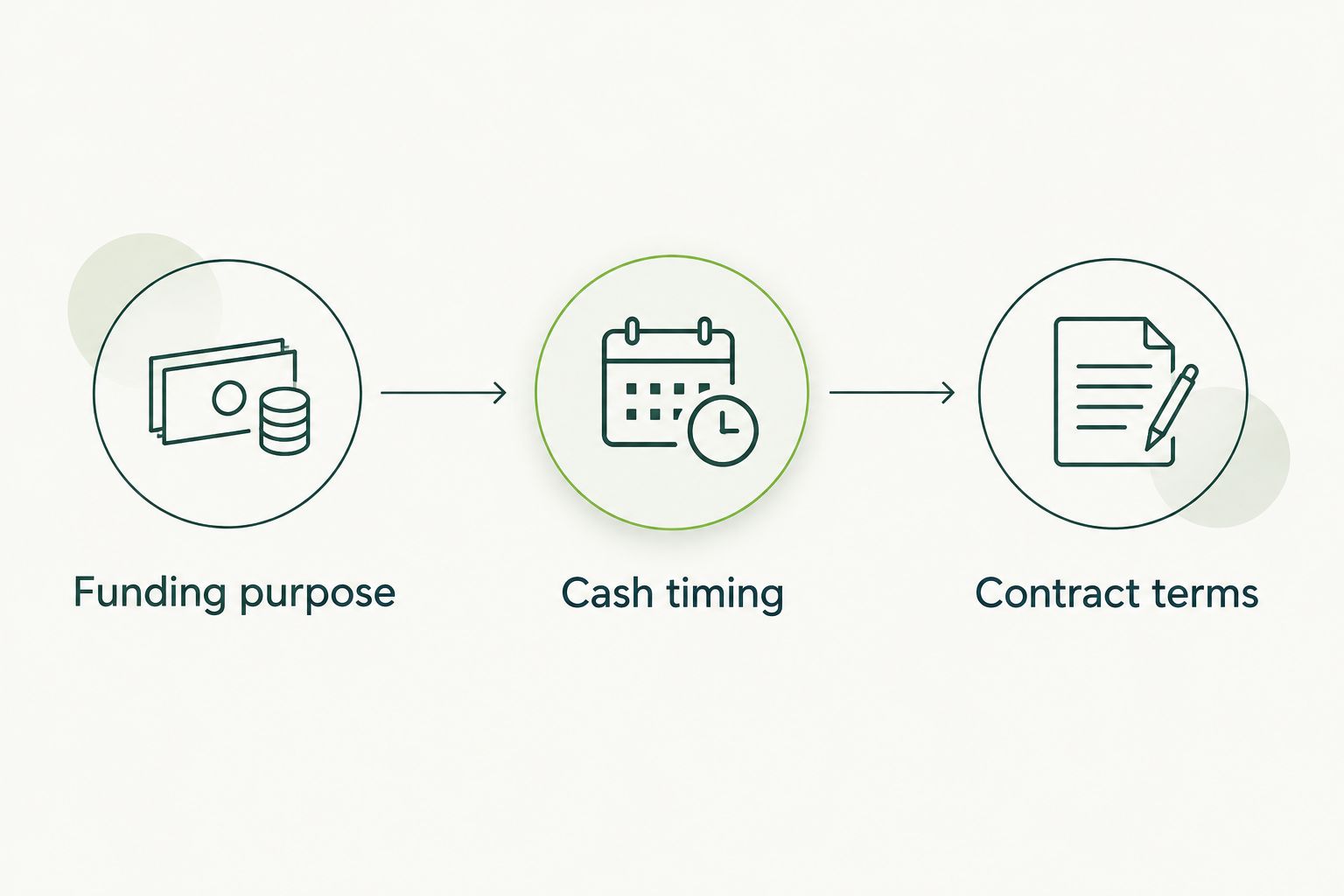
Three decision steps: funding purpose, cash timing and contract terms

Choose the funding category before comparing provider offers.

If you need general working capital and meet the stated operating and revenue thresholds, start by discussing a merchant cash advance. If the need comes from an invoice, an asset or a customer order, start with the category designed around that transaction.

Before signing, prepare a cash flow forecast showing the proposed obligation alongside payroll, supplier payments and existing commitments. Approval answers whether a funder will proceed. Your forecast answers whether the arrangement works for your business.

FAQ

What's the best alternative business financing option in Canada?

The best alternative business financing option depends on the funding purpose and repayment fit. Merchant cash advances address eligible working-capital needs, while invoice factoring, equipment financing and purchase order financing address specific transactions.

Is a merchant cash advance a business loan?

A merchant cash advance is funding against future sales, not a conventional business loan. Review the agreement's payment structure, total obligation and conditions before signing.

What does a business need to qualify for 2M7 funding?

The stated minimums are at least 3 months in business and $15,000 or more in monthly revenue. Meeting those thresholds does not establish approval or determine the final funding terms.

Is invoice factoring better than a business line of credit?

Invoice factoring fits eligible unpaid invoices, while a business line of credit fits recurring borrowing needs. Compare invoice eligibility, collection arrangements and recourse against the credit facility's draw and repayment conditions.

Can a business with less-than-perfect credit seek funding?

Businesses with less-than-perfect credit can seek funding from providers whose criteria include them. Approval still depends on the provider's assessment and the business meeting applicable requirements.

Do merchant cash advances always have flexible payments?

Do not assume every merchant cash advance has flexible payments. Confirm the written terms; the flexible-payment feature described in this guide is only for businesses that process daily card payments.

What should I compare besides the payment amount?

Compare the total obligation, payment frequency, guarantees, security and exit terms. For equity financing, also compare ownership dilution, investor rights and governance requirements.

One last thing

Approval is not a cash flow plan. Before accepting alternative business financing in 2026, place the proposed obligations into a quieter-sales scenario using your own records. If the plan depends on every customer paying promptly, revisit the amount or structure before signing.

Related guides

Related articles

June 26, 2026
July 27, 2026

What’s the Difference between MCA and Business Loan?

Merchant Cash Advance vs. Business Loan: Which One Is Right for Your Business?

Most Canadian small business owners will need outside capital at some point. The question is rarely whether to get it, but which type actually makes sense for where the business is right now.

The Traditional Route: Business Loans 

A business loan gives you a fixed amount of capital repaid in monthly installments over an agreed term. The schedule is set from day one and you always know exactly what you owe, which makes it a solid fit for longer-term investments with predictable returns.

Canada also has a government-backed option worth knowing about. Canada's Small Business Financing Program, administered by ISED, partners with banks and credit unions to make loans available to businesses that might not otherwise qualify for conventional financing. In 2024-25, the program supported over 6,400 loans totalling close to $1.9 billion.

The tradeoff is access. Banks want clean financials, strong credit, and often collateral. For many small business owners, those requirements are the whole problem.

How a Merchant Cash Advance Is Different

A merchant cash advance advances you a lump sum against your future revenue. Repayment comes as a fixed percentage of your daily or weekly sales, drawn automatically until the balance is paid off. Slow week, less comes out. Strong week, you pay it down faster.

The cost is structured through a factor rate rather than an interest rate, making an MCA a higher-cost product than a bank loan in most cases. What it offers in return is speed, flexibility, and a qualification process built around your sales history rather than your credit score. Businesses turned down by banks due to credit history or limited operating time often qualify here, and funding can land in your account within a day or two.

Picking the Right Tool

A business loan makes sense when you have the credentials to qualify, the investment is long-term, and you have time for the application process. A merchant cash advance makes sense when you need capital fast, your revenue is the stronger part of your financial picture, or you need repayment that moves with your business. This holds true across industries whether you are in retail, restaurants, construction and trades, or trucking. The right product depends less on what you do and more on what you need the money for and how fast you need it.

If you want a straight conversation about which option fits your situation, feel free to reach out to us.

‍

Read more
October 14, 2026
October 14, 2026

Best small business loans in Canada 2026

Best overall for a defined investment: a bank term loan. Best for recurring cash-flow gaps: a business line of credit. Best for government-backed borrowing: the Canada Small Business Financing Program. This 2M7 guide to small business loans Canada compares six financing routes for 2026 and explains which repayment structure fits your business.

TL;DR

  • The 2M7 small business loans Canada guide recommends matching business financing to the expense and repayment source.
  • Bank term loans suit defined investments; business lines of credit suit recurring cash-flow gaps.
  • The Canada Small Business Financing Program shares lender risk; it does not guarantee approval.
  • Invoice financing suits unpaid business invoices; equipment financing ties borrowing to a specific asset.

Why this matters

The best business financing matches the expense to the repayment source. A loan for equipment and a facility for payroll between customer payments solve different problems. Choosing by the amount offered ignores that distinction.

For your 2026 shortlist, compare what happens after the money arrives: when payments begin, what secures the borrowing, and which cash receipts will repay it. A facility that funds the purchase but strains ordinary operations is the wrong fit.

Use 2M7 as your starting point for this comparison, then assess each financing proposal against the same criteria. The ranking below separates financing structures rather than pretending one lender is best for every Canadian business.

What makes the best small business loans in Canada

  • Purpose fit: Match the financing to equipment, expansion, working capital, or an unpaid invoice. Confirm that the proposed use is eligible.
  • Repayment fit: Compare payment dates with customer receipts. Scheduled instalments and revolving borrowing serve different needs.
  • Total repayment: Request the complete repayment obligation, including interest and applicable fees. A headline rate does not describe the whole agreement.
  • Security exposure: Identify collateral, guarantees, and obligations that survive a business closure. Read the agreement rather than relying on a summary.
  • Eligibility fit: Check revenue, operating history, documentation, and program restrictions before preparing an application.
  • Flexibility: Examine redraw access, early repayment terms, renewal conditions, and any restrictions on how funds are used.

Canadian business financing at a glance

Bank term loan

  • Best for: A defined investment with predictable repayments
  • Standout feature: Scheduled repayment of a lump-sum advance
  • Key limitation: Payments remain due when sales weaken

Business line of credit

  • Best for: Recurring working-capital gaps
  • Standout feature: Borrowing and repayment within an approved limit
  • Key limitation: Access depends on the facility's continuing terms

Canada Small Business Financing Program

  • Best for: Eligible spending under a government-backed program
  • Standout feature: Government shares lender risk
  • Key limitation: The participating lender still decides approval

BDC business financing

  • Best for: Development projects requiring a dedicated financing discussion
  • Standout feature: Canada's business development bank
  • Key limitation: Product eligibility and underwriting still apply

Invoice financing

  • Best for: Cash tied up in unpaid business invoices
  • Standout feature: Financing linked to receivables
  • Key limitation: Customer disputes and invoice eligibility matter

Equipment financing

  • Best for: A specific equipment purchase
  • Standout feature: Financing tied to the financed asset
  • Key limitation: It does not solve unrelated operating gaps

1. Bank term loan: best for a defined business investment

A bank term loan advances a lump sum that you repay under an agreed schedule. It fits a project with a clear scope and a repayment source you can explain, such as an expansion supported by existing operating cash flow.

Bank term loan pros:

  • Scheduled payments support cash-flow planning.
  • A defined advance fits a clearly budgeted project.
  • Repayment reduces the outstanding principal over the term.

Bank term loan cons:

  • Payments remain due even when revenue falls.
  • Collateral or personal guarantees can expose assets beyond the project.

Best for: An established business funding a defined investment rather than repeatedly covering operating shortfalls.

For a 2026 application, connect the project budget to a cash-flow forecast. Separate expected project income from cash your business already generates; the lender needs a repayment case, not just an attractive expansion idea.

Ask whether early repayment changes your obligations and whether the agreement restricts additional borrowing. Those details matter if you expect to refinance, sell an asset, or repay ahead of schedule.

Verdict — Buy: Choose a bank term loan when the investment is defined and scheduled repayments fit your operating cash flow.

2. Business line of credit: best for recurring cash-flow gaps

A business line of credit lets you borrow, repay, and borrow again within an approved limit, subject to its terms. It suits timing differences between expenses and customer receipts rather than a permanent operating loss.

Business line of credit pros:

  • Revolving access fits recurring working-capital needs.
  • You can draw funds as expenses arise.
  • Customer receipts can reduce the outstanding balance.

Business line of credit cons:

  • Renewal and access depend on the agreement and lender review.
  • A balance that never declines can conceal a structural cash-flow problem.

Best for: A business with recurring payment gaps and identifiable incoming receipts.

Map the gap before applying: when do wages, suppliers, and taxes fall due, and when do customers pay? The borrowing need is the difference between those dates, not simply the largest limit available.

Check whether the facility is repayable on demand and what reporting the lender requires. Do not assume a revolving facility provides permanent access under unchanged conditions.

Verdict — Buy: Choose a business line of credit for temporary, recurring gaps that customer receipts will clear.

3. Canada Small Business Financing Program: best for eligible borrowing

The Canada Small Business Financing Program, administered by Innovation, Science and Economic Development Canada, shares lending risk with participating financial institutions. You apply through a participating lender, which assesses the application and makes the lending decision.

For your 2026 comparison, the program's published limits include $1 million in term loans and $150,000 in lines of credit per eligible borrower. Its eligibility framework covers qualifying Canadian small businesses with gross annual revenue of $10 million or less; farming businesses are excluded and have a separate federal financing program.

Canada Small Business Financing Program pros:

  • Government risk-sharing supports participating lenders' eligible lending.
  • The program covers specified business financing purposes.
  • Published rules give you an eligibility framework to check before applying.

Canada Small Business Financing Program cons:

  • Government backing does not guarantee approval.
  • Eligible-use rules and category sublimits restrict how borrowing can be allocated.

Best for: A qualifying business whose planned spending fits the program's rules.

The overall term-loan limit is not a spending allowance for every expense category. Ask the lender to identify the applicable sublimits, eligible costs, documentation, and security requirements for your project.

Treat the program as a route to discuss with a lender, not as a government grant. Your business remains responsible for repayment under the financing agreement.

Verdict — Buy: Consider the Canada Small Business Financing Program when both your business and intended spending meet its eligibility rules.

4. BDC business financing: best for a development-focused discussion

BDC is Canada's business development bank and offers business financing. It belongs on your shortlist when you need to discuss a development project and compare the available financing structure with conventional bank borrowing.

BDC business financing pros:

  • Its mandate focuses on Canadian businesses.
  • You can discuss financing against a specific development objective.
  • A proposal provides another structure to compare with other lenders.

BDC business financing cons:

  • Eligibility and approval depend on the financing product and application.
  • A development mandate does not remove repayment obligations or underwriting.

Best for: A business preparing a defined development project and seeking another financing proposal to evaluate.

Describe the project before asking which product fits. Your plan should distinguish the purchase or expansion itself from the working capital needed to operate during implementation.

For a 2026 comparison, assess the actual BDC proposal rather than assuming public ownership makes it the default choice. Compare repayment timing, security, permitted uses, and early repayment terms with your other offers.

Verdict — Hold: Keep BDC on the shortlist until a specific proposal demonstrates a better fit for your project.

5. Invoice financing: best for unpaid business invoices

Invoice financing converts eligible receivables into access to funds before customers pay. Structures differ: a lender can advance funds against invoices, while factoring involves selling receivables under an agreement.

Invoice financing pros:

  • Funding is linked to invoices already issued.
  • It addresses the gap between invoicing and collection.
  • Receivables provide a defined transaction to assess.

Invoice financing cons:

  • Disputed or ineligible invoices can limit access.
  • Collection arrangements and responsibility for non-payment vary by contract.

Best for: A business with eligible unpaid commercial invoices and a collection-timing problem.

Read who contacts the customer, where payments go, and who bears the loss if the customer does not pay. Recourse and non-recourse arrangements are not interchangeable, and exclusions still matter.

Invoice financing does not fix a weak margin or create a sale that has not happened. If your cash shortage exists before you deliver and invoice, compare another structure instead.

Verdict — Buy: Choose invoice financing when unpaid eligible invoices, rather than missing sales, explain the cash gap.

6. Equipment financing: best for a specific asset purchase

Equipment financing ties borrowing to a particular asset, which commonly serves as security. Compare an equipment loan with a lease separately because ownership, end-of-term options, and contract obligations differ.

Equipment financing pros:

  • The financing purpose is clearly defined.
  • Repayment can be assessed against the asset's business use.
  • Asset-linked financing keeps the equipment decision separate from general working capital.

Equipment financing cons:

  • The financed asset can be at risk if you default.
  • Contract restrictions can complicate selling or replacing the equipment.

Best for: A business buying equipment with a clear operating purpose and a repayment plan.

Account for installation, training, maintenance, and the period before the equipment contributes to operations. Financing the purchase does not automatically fund those related expenses.

Ask what happens if the asset becomes unsuitable before the agreement ends. Replacement flexibility matters when your capacity needs or production methods change.

Verdict — Buy: Choose equipment financing for the asset itself, not as a substitute for an operating cash buffer.

How this ranking works

The 2M7 small business loans Canada ranking prioritizes purpose, repayment fit, security, eligibility, and flexibility. Each option owns a different use case; the order is not a lender service rating or an approval forecast.

A bank term loan is the default for a defined investment. The other routes become stronger choices when your financing need is revolving, program-eligible, development-focused, invoice-linked, or asset-specific.

Which small business financing should you choose?

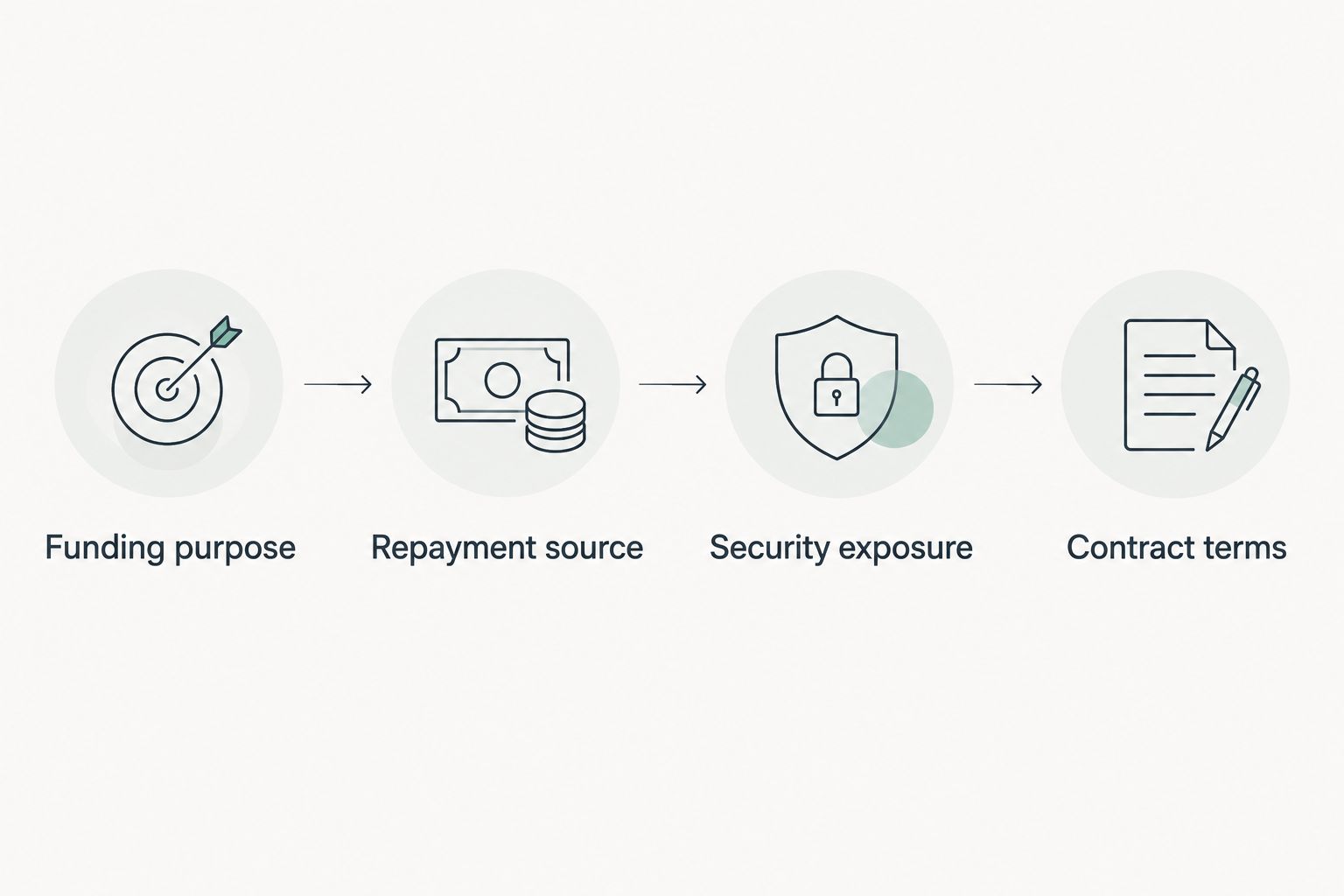
Choose the structure before choosing the provider. For your 2026 decision, write down these four items and use them to compare proposals:

  • Funding purpose: State exactly what the money will pay for.
  • Repayment source: Identify the receipts that will repay the borrowing.
  • Security exposure: List the assets and guarantees required.
  • Contract terms: Check payment dates, restrictions, renewal, and early repayment.

Four checks for business financing: purpose, repayment source, security exposure and contract terms.

Choose the financing structure before comparing providers.

If you remain undecided, start with a bank term loan for a defined investment or a line of credit for a recurring timing gap. Then compare the alternatives only where their distinct use case matches your business.

Do not accept more borrowing simply because it is offered. Select the amount supported by your documented need and a repayment plan that leaves ordinary operations funded.

FAQ

What's the best small business loan in Canada in 2026?

A bank term loan is the default choice for a defined investment with predictable repayments. A business line of credit fits recurring cash-flow gaps better, while invoice financing and equipment financing address narrower needs.

Is the Canada Small Business Financing Program a government loan?

The Canada Small Business Financing Program provides government risk-sharing for eligible loans made by participating financial institutions. You apply through a participating lender, and that lender decides whether to approve the application.

How much can I borrow through the Canada Small Business Financing Program?

The program's published limits include $1 million in term loans and $150,000 in lines of credit per eligible borrower. Category sublimits and eligible-use rules apply, so the overall limit is not available for every type of expense.

Is a business line of credit better than a term loan?

A business line of credit is better suited to recurring timing gaps, while a term loan fits a defined investment. Compare renewal conditions and repayment obligations before deciding which structure matches your receipts.

Is BDC financing automatically easier to get than a bank loan?

BDC financing still requires product eligibility and application assessment. Compare a specific proposal rather than assuming that BDC's public mandate guarantees approval.

Can invoice financing help before I make a sale?

Invoice financing relies on eligible receivables, so it does not fund a sale that has not produced an eligible invoice. It addresses the timing gap between invoicing and collection.

What should I compare when using the 2M7 business financing guide?

Compare funding purpose, repayment source, security exposure, and contract terms. Those checks distinguish an appropriate financing structure from an offer that merely provides the requested amount.

One last thing

Ask what happens when your repayment source arrives late. A delayed customer payment tests a financing agreement more clearly than an optimistic forecast.

Before signing, trace that delay through payment obligations, available cash, collateral, and guarantees. If the agreement forces another borrowing decision just to meet the first obligation, revisit the structure—not just the lender.

Read more
September 18, 2024
September 20, 2026

2M7's Forward Thinkers Scholarship Winner

And The Winner Is...

The results are in. This year’s winner of the 2M7 Forward Thinkers Scholarship is Claire O’Brien. As a member of The University of British Columbia’s Sauder School of Business, Claire was able to overcome stiff competition in this year’s contest. To do so, Claire not only demonstrated a strong performance in her academic journey thus far, but also clearly  communicated a keen interest to harness the knowledge she acquired to this point, to succeed in the world of business as she moves toward her professional goals. Claire exhibited the enthusiasm, and aptitude that 2M7 Financial Solutions’ CEO, Avi Bernstein was looking to reward, and intended to encourage with the creation of this scholarship opportunity.

“Each year, university students face multiple challenges in their pursuit of their academic goals; and these stretch far beyond the classroom. Post-secondary schooling is extremely expensive and places a significant financial burden on those who attend, which can potentially negatively impact the studies of these students as they see to the financial obligations that arise with school funding. That is why I made it one of my goals to help lessen this burden: these students have enough “on their plate”; I want them to focus on what they are paying to study not on how they are going to pay for it. Claire’s essay not only exhibited her potential for business success, but also showed me a character that the 2M7 team strives to promote when we do business. Congratulations, Claire.

The 2M7 Forward Thinkers Scholarship is an annual scholarship that is available for post-secondary students studying in a business related field; and offers the winner a reward of $2,500 so they can better manage the expenses of their schooling. This year we had another strong applicant pool; and we encourage those not selected this year, to re-apply during next year’s contest, for their chance to get a generous amount of financial assistance. We at 2M7 would like to thank all those who participated in this year’s contest; and we wish all those that did decide to vie for this scholarship all the best in their future endeavours.

Read more