ClickCease

The Real Cost of Waiting: How Delayed Funding Affects Small Businesses

The Real Cost of Waiting: How Delayed Funding Affects Small Businesses

21
Oct 2026
21
Oct 2026

A supplier offers you forty thousand dollars of inventory at sixty cents on the dollar, but only if you can wire the deposit by Friday. A commercial tenant space opens up two blocks from your restaurant's biggest competitor, and the landlord wants a signed lease within the week. A trucking client needs three more units on the road for a contract starting next month. These moments do not wait for anyone, least of all a bank.

Most business owners understand financing math in the abstract. They know interest rates, they know what a personal guarantee means, they know roughly what their credit score should look like. What fewer owners have priced out is the cost of time itself, the weeks that disappear between applying for a loan and actually having usable cash. That gap is not neutral. It is where opportunities go to die.

‍

Banks Are Approving More Loans, Just Not Quickly

There is a common assumption among small business owners that traditional lenders have tightened up and that is why approvals feel so hard to come by. The data tells a more complicated story. According to ISED Canada, the approval rate for small business debt financing actually climbed to 97 percent in 2025, up sharply from 89 percent the year before, and the share of requested funds that lenders actually authorized also reached 97 percent, the highest ratio recorded since 2015.

Read that again. Banks are saying yes more often than they have in a decade, and they are authorizing close to the full amount requested. So why does it still feel like pulling teeth to get money into your account?

Because approval and funding are two different events, separated by underwriting queues, document requests, credit committee schedules and internal risk reviews that were never built with urgency in mind. A "yes" that arrives four to six weeks after you applied is not the same as a "yes" you can act on. For a seasonal retailer or a contractor bidding on spring work, a technically approved loan that lands after the window has closed is functionally a rejection.

‍

‍

What Slow Money Actually Costs

Owners tend to think about the cost of financing in terms of interest rate alone. That is only half the equation. The other half is opportunity cost, and it rarely shows up on a spreadsheet until it is too late to fix.

Consider inventory. A retailer who cannot move fast on a bulk buy loses the margin on that deal permanently, and often loses shelf space to a competitor who could move. According to BDC, businesses that misjudge their seasonal cash position frequently end up carrying either too much stock, which ties up capital and risks obsolescence, or too little, which means missing the sales window entirely. BDC points out that a seasonal operator such as a restaurant can see monthly sales swing from fifty or sixty thousand dollars in the off-season to two or three hundred thousand at peak, a gap wide enough that a few weeks of delayed working capital can decide whether that peak season is profitable or merely busy.

Contractors face a version of this that is even less forgiving, since weather windows and material costs move on their own calendar regardless of when a bank finishes its paperwork. A framing crew that cannot lock in lumber pricing before a spring increase, or a contractor who cannot mobilize equipment in time for a short building season, is not losing a little margin. They are sometimes losing the entire project to a competitor who financed faster.

Trucking operators know this rhythm too. Fleet expansion, trailer repairs and fuel costs do not pause while an application sits in a queue, and a truck parked waiting on financing is a truck earning nothing.

‍

The Real Price Tag Is Compounding, Not Fixed

The mistake most owners make is treating a slow approval as a one-time inconvenience rather than a recurring tax on the business. Every deal missed because funding arrived too late becomes a data point that shapes future decisions, usually toward caution. Owners stop chasing good opportunities because they have learned, through repeated frustration, that their capital cannot move fast enough to capture them. That is a much bigger loss than any single missed inventory deal. It is a business permanently operating below its own potential because its financing infrastructure cannot keep pace with its ambition.

Add to this a macro backdrop where interest rates and lending appetite continue to shift year over year, and the businesses that win are not necessarily the ones with the best credit profile on paper. They are the ones whose capital access matches the speed of their market.

‍

Where 2M7 Fits Into That Equation

This is precisely the gap 2M7 was built to close. We work with restaurants, retail operators, construction and contracting businesses, and trucking companies all across Canada. 2M7 offers Merchant Cash Advances built around one principle: fast business funding is not a luxury feature, it is the entire value proposition. We work with owners who have been turned away elsewhere because of bad credit, structuring financing around actual business performance and cash flow rather than a credit score alone. 

We are not a bank, and we do not operate on bank timelines. Where a traditional lender might take weeks to move an approved file into funded cash, our process is built to get capital into your account in days, because a deal, a deposit deadline or a seasonal window rarely gives you weeks to work with.

‍

The Decision Is Simple

If your business has ever missed an opportunity because financing took too long, that is not a one-time bad break. It is a pattern that will repeat until you change which lender you call first. Contact 2M7 directly, walk us through what you need funded, and find out what your options look like when they’re on time.

‍

‍

Related articles

July 16, 2026
July 26, 2026

The Future of Alternative Lending in Canada

Canadian small business owners have never had a more complicated relationship with capital. The cost of materials is up, hiring is expensive, and the big banks, despite a series of interest rate cuts over the past year, are still not exactly rolling out the welcome mat. A 2025 survey by Equifax Canada found that 25% of small and medium business owners cited credit availability from banks or suppliers as one of their top concerns heading into the final quarter of the year. That number tells a story most business owners already know by heart.

The good news is that a parallel financial system has been quietly maturing alongside the traditional one. Alternative lending in Canada is no longer a last resort. It is becoming the first call.

The Market Is Growing Fast, For Good Reason

According to Research and Markets, Canada's alternative lending market reached an estimated $18.42 billion in 2025, following a compound annual growth rate of 16% from 2020 to 2024, with projections putting that figure at roughly $30.59 billion by 2029. Those are not niche numbers. That is a structural shift in how Canadian businesses fund themselves.

The reasons are not hard to find. According to the Bank of Canada's Business Outlook Survey for Q4 2025, business sentiment remained subdued, with firms pointing to trade-related uncertainty, slowing demand, and persistent cost pressures as their most pressing concerns. When cash flow is tight and the economic environment is uncertain, waiting three weeks for a bank decision is not a viable strategy. Businesses need answers faster, and alternative lenders have built their entire model around that reality.

What "Alternative" Actually Means in Practice

The term gets used loosely, so it is worth being specific. Alternative lending covers working capital loans, revenue-based financing, equipment financing, invoice factoring, and lines of credit. One of the most practical tools in this category is the merchant cash advance, which gives a business a lump sum in exchange for a percentage of future revenue. There is no fixed monthly payment grinding against a slow week. Repayment breathes with the business, which makes it particularly well-suited to operators with variable or seasonal revenue.

For industries like construction, retail, trucking, and food service, that kind of structural flexibility is not a nice-to-have. It is the difference between taking a contract and turning one down.

The Speed Problem Banks Still Have Not Solved

A contractor who wins a large job but needs equipment before the first draw arrives has a real and immediate problem. Alternative lenders who work with trades and construction businesses understand the cash flow cycle of that industry and can structure a deal accordingly, often with capital in hand within days. A retailer staring at a seasonal inventory window that will not wait for bank paperwork faces the same math. The problem is timing. The solution is fast business funding from a lender who understands the sector.

Speed alone, though, is not the whole value proposition. The better alternative lenders are also smarter about who they will fund.

Credit Scores Are Not the Whole Story

Traditional banks lean heavily on credit scores and historical financials. They want two or three years of clean statements, solid collateral, and a business that practically does not need a loan to qualify for one. Alternative lenders are increasingly looking at revenue patterns, bank statement trends, and business trajectory instead. A business with a rough patch in its history but strong current cash flow is a very different risk than its credit report might suggest.

That nuance matters enormously to the owner who went through a hard year during a supply chain disruption or a pandemic slowdown and rebuilt. The reality is that a lot of viable businesses carry bruised credit, and the full picture of a business cannot be reduced to a three-digit number.

Open Banking and the Technology Layer

There is a regulatory development worth watching closely. Canada's consumer-driven banking framework, commonly called open banking, is set to launch in 2026, designed to replace risky online password sharing with secure data connections and to increase competition in the financial services sector. For alternative lenders, this matters. Open banking means faster, more accurate access to financial data with the borrower's consent, underwriting decisions made in hours rather than days, and a cleaner picture of a business's actual financial health.

For borrowers, it means less paperwork. The loan application process, already streamlined by the better alternative lenders, will get faster still.

AI-powered underwriting is part of this picture too. Decisions that once required manual review are increasingly automated, and lenders are getting better at identifying creditworthy businesses that traditional models would have rejected. The businesses that benefit most are exactly the ones that have been underserved the longest: service businesses with thin assets but strong revenue, newer operators without years of statements, and owners in industries that banks have always found difficult to assess.

Sector-Specific Lending Is Maturing

A trend that deserves more attention is the rise of industry-specific lending. Generic small business loans are fine, but a lender who understands the cash flow cycle of a specific industry will structure a deal differently than one who treats every file the same way.

Trucking is a good example. Owner-operators often invoice on 30- to 60-day terms while fuel costs hit weekly. Getting capital from a lender who actually understands the trucking industry means repayment gets structured around that reality, rather than creating a cash flow problem with the solution itself. Sector fluency is increasingly a real differentiator in this space.

The Road Ahead

The trajectory for alternative lending in Canada is clear. The gap that banks leave in the small business credit market is not getting smaller. The technology powering faster and smarter lending decisions keeps improving. And Canadian entrepreneurs are becoming more financially literate about their options, less willing to accept a bank rejection as the final word.

The businesses that will thrive in this environment are the ones that treat capital access as a skill, not a crisis response. Knowing your options before you need them is a genuine competitive advantage.

2M7.ca works with Canadian small business owners across industries to find the right funding structure for their situation, whether it is their first alternative loan or their tenth. If you have questions about what the best option is for your business, feel free to reach out to us.

‍

Read more
October 19, 2026
October 19, 2026

Best equipment financing for trucking companies in Canada 2026

Best overall for truck ownership: an equipment loan. Best for planned replacement: an equipment lease. Best for recurring repair bills: a business line of credit. Best for equipment-related working capital: a merchant cash advance when its repayment terms fit your revenue. This 2026 guide compares equipment financing for trucking companies by purpose, ownership and cash flow, rather than treating every funding option as interchangeable.

TL;DR

  • Equipment financing for trucking companies starts with a choice: finance the vehicle or fund the business around it.
  • Equipment loans suit ownership; equipment leases suit businesses that prefer use over immediate ownership.
  • Business lines of credit suit recurring operating expenses, subject to approved terms and limits.
  • 2M7 provides merchant cash advances for Canadian businesses seeking equipment-related working capital, not conventional equipment loans.

Why this matters

A truck purchase and a repair-related cash flow gap are different funding problems. A vehicle can support your business for years, while a repair bill needs to be matched against the cash available after the truck returns to work.

Match the funding structure to the expense before comparing providers. Otherwise, you can end up using operating cash for a long-term asset or taking on a repayment schedule that leaves too little room for fuel, insurance and payroll.

2M7 is a Canadian direct funder, not a broker, offering merchant cash advances and working capital. That makes it relevant to equipment-related cash needs, but not interchangeable with a lender financing a specific truck.

What makes the best trucking equipment financing?

Use these criteria to compare your 2026 options before requesting an offer:

  • Funding purpose: Separate buying a truck from paying for repairs, equipment, payroll or a cash flow gap.
  • Ownership: Establish who owns the equipment during the agreement and what happens at the end.
  • Cash flow: Compare payment timing with actual collections, not just the dates you issue invoices.
  • Security: Identify the truck, other assets or guarantees covered by the agreement.
  • Total obligation: Review the complete repayment obligation, charges and end-of-term requirements in writing.
  • Eligibility: Check business history, revenue, credit and equipment requirements before preparing an application.

No option wins every category. A suitable purchase agreement can still be unsuitable for recurring expenses, and an accessible working capital offer can still put pressure on operating cash.

Trucking equipment financing at a glance

Equipment loan

  • Best for: Buying a truck you intend to keep
  • Standout feature: Financing tied to an equipment purchase
  • Key limitation: Security and repayment obligations require close review

Equipment lease

  • Best for: Using equipment with a planned replacement strategy
  • Standout feature: Contract defines equipment use and end-of-term choices
  • Key limitation: Ownership is not automatic

Business line of credit

  • Best for: Recurring repairs and operating expenses
  • Standout feature: Reusable borrowing capacity under the agreement
  • Key limitation: Approval, limits and renewal terms constrain access

Merchant cash advance

  • Best for: Equipment-related working capital supported by business revenue
  • Standout feature: Funding assessed against the operating business
  • Key limitation: It is not a substitute for reviewing truck-specific financing

These are financing structures, not a ranking of named lenders. Actual suitability depends on the written offer, your business finances and the equipment involved.

1. Equipment loan: best for long-term truck ownership

An equipment loan finances an equipment purchase through a lending agreement. For a trucking company buying a vehicle it intends to keep, it is the clearest starting point because the funding decision centres on the asset and the business's ability to repay.

Ask whether the lender accepts the truck's age, condition, seller and intended use. Do not assume an offer for one vehicle applies to another, even when both serve the same route.

Equipment loan pros:

  • Connects the financing request to a defined equipment purchase.
  • Supports an ownership-focused fleet plan.
  • Provides a repayment schedule you can assess against operating cash flow.

Equipment loan cons:

  • Security arrangements can restrict your ability to sell or refinance the truck.
  • Payments continue when the truck is idle or undergoing repairs, unless the agreement provides otherwise.

Best for: An established owner-operator or fleet buying equipment for continued use.

Before accepting an equipment loan in 2026, ask what happens if you sell the truck, repay early or need to replace it after a breakdown. Also confirm whether the agreement covers only the equipment or requires additional security.

Verdict: Buy through an equipment loan when ownership is the goal and the payment leaves room for maintenance and downtime.

2. Equipment lease: best for a planned replacement strategy

An equipment lease gives your business the right to use equipment under a contract. The agreement determines payments, responsibilities and what happens when the lease ends.

A lease belongs on your shortlist when access to the truck matters more than immediate ownership. It requires careful end-of-term planning, not just a comparison of periodic payments.

Equipment lease pros:

  • Separates the decision to use equipment from outright ownership.
  • Can support a defined equipment replacement plan.
  • Establishes contractual choices for the end of the lease.

Equipment lease cons:

  • Returning or purchasing the equipment depends on the specific agreement.
  • Usage, condition and early termination provisions can limit flexibility.

Best for: A trucking company with a clear replacement plan and predictable equipment requirements.

Request the full end-of-term wording before signing. Check for purchase obligations, return conditions and any restrictions that conflict with your intended operation. Do not assume maintenance, insurance or repairs are included simply because the vehicle is leased.

For a 2026 comparison, put the lease's total obligations beside the equipment loan's total obligations. A smaller periodic payment does not establish which agreement is better for your business.

Verdict: Buy into a lease only when its use restrictions and end-of-term terms fit your fleet plan.

3. Business line of credit: best for recurring repair expenses

A business line of credit lets you borrow within an approved limit under the lender's terms. Its main role in trucking is managing recurring operating expenses, rather than replacing a dedicated truck-purchase agreement.

Repairs, parts and maintenance do not always line up with customer collections. A credit line gives you a structure to assess those repeated cash needs without treating each expense as a separate equipment acquisition.

Business line of credit pros:

  • Provides reusable borrowing capacity under the agreement.
  • Supports different operating expenses rather than one named asset.
  • Lets you distinguish short-term cash needs from long-term equipment ownership.

Business line of credit cons:

  • Approved limits and renewal conditions can constrain your plans.
  • A continuously drawn balance can conceal an unresolved operating shortfall.

Best for: A trucking business with recurring expenses and a credible plan to restore available credit from collections.

Check whether the facility is secured, what reporting is required and how repayment works. Ask about the lender's rights to change or demand repayment of the facility; do not assume access remains unchanged indefinitely.

If your plan depends on keeping the line fully drawn, reassess the underlying cash flow. Reusable credit works best when your business can repay drawings, not simply move expenses into a growing balance.

Verdict: Hold off on using a line of credit for a truck purchase unless the written terms and repayment plan support that use.

4. Merchant cash advance: best for equipment-related working capital

A merchant cash advance provides business funding through an agreement distinct from a conventional equipment loan. Consider it when the need extends beyond acquiring a vehicle, such as equipment expenses alongside payroll, inventory or a cash flow gap.

2M7 is best suited to Canadian businesses seeking merchant cash advance working capital, rather than a conventional truck-purchase loan. It serves businesses operating for at least 3 months with $15,000 or more in monthly revenue, including businesses with less-than-perfect credit.

Merchant cash advance pros:

  • Addresses operating-business needs, including equipment-related expenses.
  • Offers an alternative structure to conventional equipment borrowing.
  • Provides a direct-funder option through 2M7, without a broker between the business and funder.

Merchant cash advance cons:

  • It is not an equipment loan and should not be compared as though the contracts are identical.
  • Repayment obligations still need to fit cash flow after essential operating expenses.

Best for: A revenue-generating Canadian business that meets the funder's requirements and needs working capital rather than asset-specific financing.

For 2M7 working capital, the cost structure is one fixed cost of capital shown before signing; it does not change based on how long repayment takes. Review the total obligation and repayment mechanism alongside your other written offers. Flex payments are only for businesses that process daily card payments, so do not assume that feature applies to a trucking operation paid through invoices.

Verdict: Buy into a merchant cash advance only when its business purpose and repayment terms fit your collections.

How to compare your written offers

Use the same sequence for every 2026 offer. Comparing unlike figures, such as a lease payment against an advance amount, does not tell you which agreement fits.

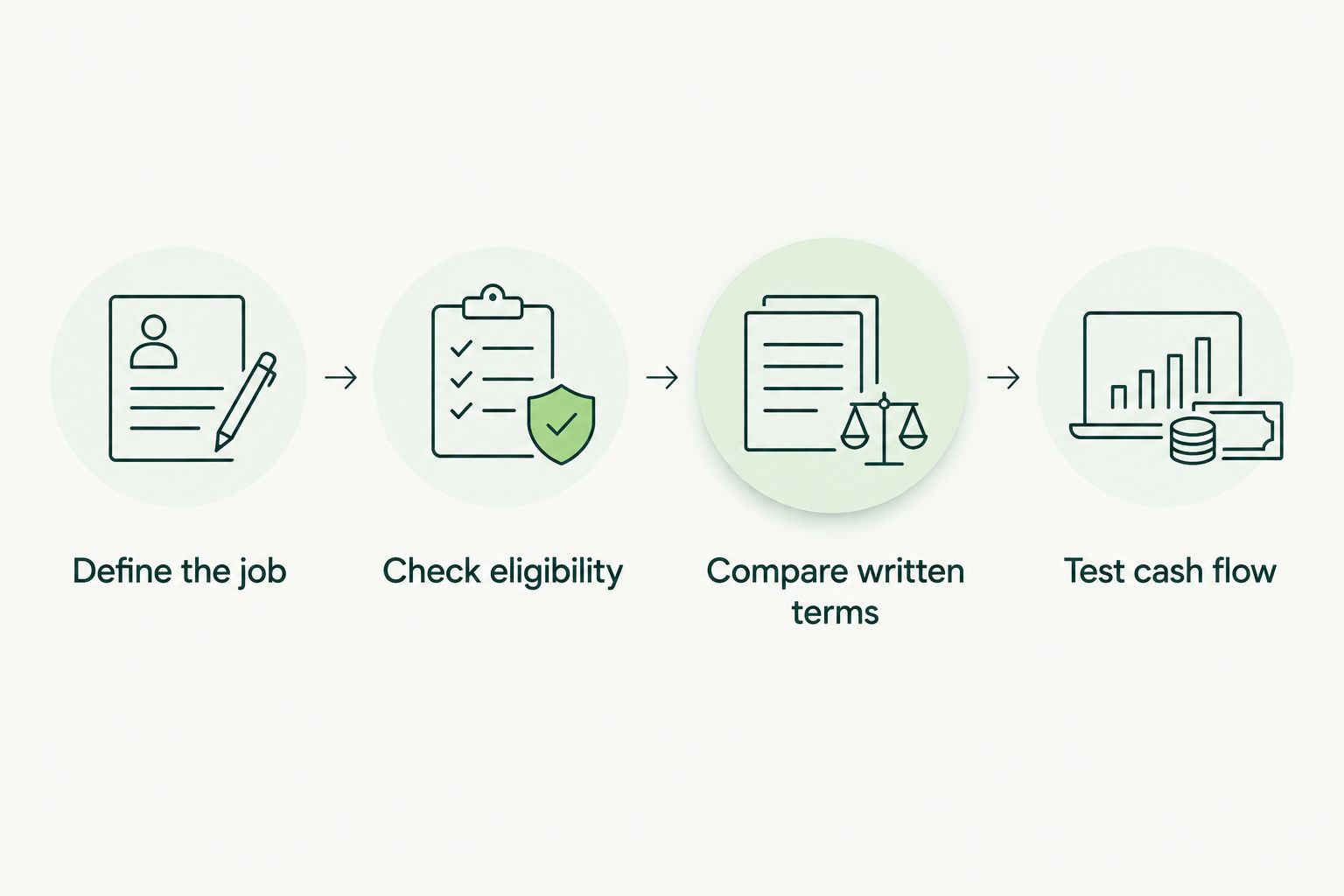
  1. Define the job: Write down whether you need a truck, a repair, replacement equipment or operating cash. Separate expenses that serve different purposes.
  2. Check eligibility: Confirm business, revenue, credit and equipment requirements before committing to an application process.
  3. Compare written terms: Record the amount provided, total obligation, payment timing, security, guarantees and exit conditions.
  4. Test cash flow: Place repayments beside expected collections and essential expenses. Check what happens during downtime or delayed customer payments.

A workable offer leaves your business able to operate the truck after obtaining the funding. Approval alone does not answer that question.

Four steps for comparing trucking equipment funding offers

Start with the expense and finish by testing the repayment against operating cash flow.

How the options are ranked

The ranking follows funding purpose, ownership, cash flow, security, total obligation and eligibility. Equipment loans lead for ownership; leases serve planned use and replacement; credit lines address recurring expenses; merchant cash advances address operating-business funding needs.

This is a purpose-based buying guide, not a claim that one provider offers the lowest cost or approves every trucking business. Compare the actual contracts before choosing.

Which equipment financing should you choose?

Start with an equipment loan if you are buying a truck you intend to keep. Compare a lease when your priority is equipment use with a defined replacement plan.

Choose a business line of credit for recurring expenses only when you can explain how collections will repay drawings. Consider a merchant cash advance when the need is working capital and the agreement fits your revenue.

For your 2026 decision, keep the truck purchase and the operating reserve separate on paper. You need to know both how you will acquire the equipment and how you will keep it earning.

Discuss your funding options

Speak with a funding specialist about working capital for your Canadian business.

Discuss funding options

FAQ

What's the best equipment financing for trucking companies in Canada?

An equipment loan is the strongest starting point when your goal is to buy and keep a truck. Compare a lease for planned equipment use, a credit line for recurring expenses and a merchant cash advance for working capital needs.

Is leasing a truck better than financing a purchase?

Leasing is better suited to a use-and-replacement plan, while an equipment loan suits an ownership plan. Compare total obligations, return conditions, security and early exit terms before choosing.

Can I use working capital for truck equipment?

Working capital can support equipment-related business expenses when the funding agreement permits the use. Separate the equipment expense from ongoing payroll, fuel and maintenance so you can assess the full cash requirement.

Does 2M7 offer conventional equipment loans?

2M7 provides merchant cash advances and working capital, not conventional equipment loans. It is a Canadian direct funder, not a broker.

Can a newer trucking business qualify for a merchant cash advance?

The stated eligibility baseline is at least 3 months in business and $15,000 or more in monthly revenue. Meeting that baseline does not establish approval or the terms of an offer.

What should I check before signing a trucking finance agreement?

Check the total obligation, payment timing, security, guarantees and early exit terms. For leases, also check equipment return conditions and any purchase requirements.

Do flexible payments apply if customers pay trucking invoices?

Do not assume flexible payments apply to invoice-based collections. The flex-payment feature described here is only for businesses that process daily card payments.

One last thing

The truck payment is not the truck's full cash requirement. Before signing, put fuel, insurance, maintenance, payroll and a downtime allowance beside the proposed repayment. An agreement that fits only while every invoice arrives on time does not leave your business room to handle disruption.

Related guides

Read more
October 14, 2026
October 14, 2026

Best equipment financing options in Canada 2026

Best overall for long-term ownership: an equipment loan. Best for planned replacement: an equipment lease. Best for flexible purchases: a business line of credit. This 2M7 guide compares equipment financing options in Canada for 2026 by ownership, cash flow and contract restrictions—not by advertised payments alone.

TL;DR

  • 2M7’s equipment financing Canada guide ranks equipment loans first for businesses seeking long-term ownership.
  • Equipment leases suit planned replacement, but return conditions and purchase options need close review.
  • Business lines of credit suit flexible purchases when repayment does not crowd out operating cash.
  • Compare vendor-arranged financing with direct financing using the same equipment quote and repayment assumptions.

Why this matters

Equipment financing affects more than your payment schedule. It determines whether you own the asset, what security the financier takes and what happens when you replace or sell the equipment.

A payment that fits today does not settle the decision. Your business also needs enough cash for maintenance, insurance, payroll and periods when the equipment produces less revenue.

For 2026, start with the asset’s job in your business. A machine you intend to keep needs a different financing assessment from equipment you expect to replace as your work changes.

What makes the best equipment financing option?

Use these criteria before comparing offers. The strongest option fits the equipment’s working life and your repayment capacity without creating an unwanted exit obligation.

  • Ownership: Decide whether you need title to the equipment or only the right to use it.
  • Payment fit: Match scheduled obligations to cash your business can reliably generate, not its busiest period.
  • Total obligation: Compare the full payment schedule, fees and any required final payment or purchase amount.
  • Security: Identify the assets pledged and whether a personal guarantee is required.
  • Exit terms: Check early repayment, early termination, sale restrictions and end-of-term responsibilities.
  • Asset fit: Confirm that the proposed arrangement accepts the specific equipment, condition and intended use.

Ask for written terms. A verbal explanation of ownership or an end-of-term purchase option is not a substitute for the contract.

Equipment financing options at a glance

These 5 financing routes serve different needs. Vendor-arranged financing describes how you obtain the offer; the underlying contract can still be a loan or lease.

Equipment loan

  • Best for: Long-term ownership
  • Standout feature: Finances an equipment purchase with scheduled repayment
  • Key limitation: Security and repayment obligations remain until discharged

Equipment lease

  • Best for: Planned replacement
  • Standout feature: Provides equipment use under an agreed lease term
  • Key limitation: Ownership and exit depend on the contract

Business line of credit

  • Best for: Flexible purchases
  • Standout feature: Allows borrowing and repayment within an approved facility
  • Key limitation: Equipment debt can consume working-capital capacity

Vendor-arranged financing

  • Best for: Purchase coordination
  • Standout feature: Connects the equipment purchase with a financing application
  • Key limitation: Convenience does not establish the best financing terms

Secured business loan

  • Best for: Equipment within a broader project
  • Standout feature: Can fund an eligible project containing equipment and other expenses
  • Key limitation: Security can extend beyond the purchased equipment

The table ranks financing structures, not lenders. Approval criteria, documentation and contract terms differ between providers, so the same structure can produce very different obligations.

1. Equipment loan: best equipment financing for long-term ownership

An equipment loan finances the purchase of equipment and requires repayment under an agreed schedule. The business purchases the asset, while the lender can take security over it or other agreed assets.

An equipment loan is the default choice when ownership is the goal and scheduled repayments fit the business. That does not make every equipment loan suitable: the security agreement, repayment terms and asset restrictions still decide whether the offer works.

Equipment loan pros

  • Supports purchasing equipment you intend to keep.
  • Provides a defined repayment schedule under the agreement.
  • Separates the purchase from a lease-return decision.
  • Lets you assess financing alongside the equipment’s expected working life.

Equipment loan cons

  • Repayments continue even when the equipment is idle.
  • Security requirements can restrict disposal of the asset.
  • Early repayment conditions require review before signing.

Best for: Businesses buying equipment for continuing use rather than routine replacement.

Before accepting a 2026 equipment loan, ask what happens if the asset needs replacement before repayment ends. You need to know whether sale proceeds can discharge the financing, whether lender consent is required and whether any remaining balance survives the sale.

Verdict — Buy: Choose an equipment loan when you want ownership and can support the repayment schedule through quieter trading periods.

2. Equipment lease: best equipment financing for planned replacement

An equipment lease gives your business the right to use equipment under an agreement with the lessor. The contract determines the payment schedule, permitted use, maintenance responsibilities and end-of-term choices.

A lease is not automatically a path to ownership. If ownership matters, identify the purchase option and its conditions before comparing the lease with a loan.

Equipment lease pros

  • Suits businesses focused on equipment use rather than immediate ownership.
  • Establishes a defined term for the equipment arrangement.
  • Allows a planned end-of-term decision where the contract provides suitable choices.
  • Can align with a replacement plan when the lease conditions support it.

Equipment lease cons

  • Early termination can create contractual obligations.
  • Return conditions can add work and expense at the end.
  • A purchase option is not the same as an unconditional transfer of ownership.

Best for: Businesses with a defined replacement plan and equipment needs that fit the lease term.

For a 2026 lease comparison, request the return requirements alongside the payment schedule. Equipment condition, transport responsibilities and notice deadlines belong in the decision, not in a separate file you read later.

Also distinguish financing from service. Maintenance, repairs and replacement equipment are included only when the agreement explicitly says so.

Verdict — Buy: Choose an equipment lease when the use period and end-of-term obligations match your replacement plan; skip it when ownership terms are unclear.

3. Business line of credit: best equipment financing for flexible purchases

A business line of credit allows borrowing within an approved limit under the facility’s terms. It can fund equipment purchases where the agreement permits that use, without a separate equipment-financing contract for each purchase.

Flexibility is its main advantage. The trade-off is that the equipment purchase uses capacity your business might otherwise need for operating expenses.

Business line of credit pros

  • Supports purchases at different times within the approved facility.
  • Allows repayment and further borrowing under the agreement.
  • Avoids matching every purchase to a separate equipment contract.
  • Provides flexibility when the final purchasing schedule is uncertain.

Business line of credit cons

  • Equipment borrowing reduces remaining credit capacity.
  • Variable-rate terms expose borrowing costs to rate changes.
  • An accessible facility still needs a deliberate repayment plan.

Best for: Businesses making flexible purchases while preserving enough unused capacity for operations.

Do not treat the available limit as an equipment budget. First reserve the capacity needed for supplier payments, payroll and revenue interruptions, then assess what remains.

Compare a line of credit with a dedicated equipment loan when the purchase will stay financed for a long period. Flexible borrowing is useful only if the repayment plan fits the asset and does not leave operating cash permanently constrained.

Verdict — Hold: Use a business line of credit for equipment only after setting a repayment plan and protecting working-capital capacity.

4. Vendor-arranged financing: best equipment financing for purchase coordination

Vendor-arranged financing connects an equipment purchase with a financing offer or application through the seller. The seller might introduce a financing provider or present an arrangement available for that purchase.

This is a purchasing channel, not a distinct financial contract. Determine whether the actual offer is a loan, lease or another agreement before assessing its suitability.

Vendor-arranged financing pros

  • Coordinates the equipment quote with the financing application.
  • Keeps the proposed asset clearly identified during the process.
  • Gives you an offer to compare with independently obtained financing.

Vendor-arranged financing cons

  • The presented offer does not represent every financing option.
  • Purchase convenience can distract from security and exit terms.
  • The financing provider and equipment seller can be separate parties.

Best for: Buyers who want coordinated purchasing but will still compare the written financing agreement.

Request the equipment quote separately from the financing schedule. This makes it easier to compare the same asset across offers without confusing equipment charges with financing obligations.

For a 2026 purchase, ask who handles an equipment dispute and who collects payments. Do not assume a dispute with the seller automatically pauses obligations to a separate financier.

Verdict — Hold: Consider vendor-arranged financing after comparing its underlying contract with a direct financing offer for the same equipment.

5. Secured business loan: best equipment financing for a broader project

A secured business loan can fund eligible business purposes under the lender’s agreement. Equipment can form part of a wider project that also includes installation, premises work or other approved expenses.

This route deserves consideration when the equipment purchase is only one part of the funding need. Its central limitation is the security package: assets beyond the equipment can be pledged.

Secured business loan pros

  • Can address an eligible project rather than an isolated asset purchase.
  • Allows equipment and related approved expenses to be assessed together.
  • Provides a repayment structure for the agreed borrowing.

Secured business loan cons

  • Security can extend beyond the financed equipment.
  • Broader funding needs require careful documentation of eligible uses.
  • Project delays do not automatically change repayment obligations.

Best for: Businesses funding equipment within a defined expansion or installation project.

Separate the equipment budget from the rest of the project before applying. You need to understand which expenses the proposed facility covers and which must come from existing cash.

Compare this route against a dedicated equipment loan plus separately funded project expenses. The choice depends on repayment fit and security exposure, not simply whether one agreement feels easier to administer.

Verdict — Hold: Choose a secured business loan when the wider project justifies it and the pledged assets are acceptable.

How the options are ranked

This 2M7 equipment financing guide ranks each route by its clearest use case: ownership, planned replacement, purchasing flexibility, purchase coordination or broader project funding.

Equipment loans take the default position because they directly address an equipment purchase with ownership as the objective. Leases take the replacement slot; lines of credit take the flexibility slot. Vendor arrangements and broader secured loans require an additional check because the channel or project scope does not itself establish suitable financing terms.

No ranking substitutes for reviewing the actual contract. An unsuitable equipment loan loses to a lease that genuinely fits your business.

Check cash flow before choosing

Build a 12-month cash-flow forecast that includes the proposed financing obligations and equipment operating expenses. Use 3 cash-flow scenarios: expected trading, weaker revenue and an equipment interruption.

Follow this sequence before signing:

  • Define ownership: State whether you need to own the asset or use it for a defined period.
  • Check obligations: Include scheduled payments, required fees and end-of-term commitments.
  • Stress cash flow: Test repayment alongside payroll, suppliers, maintenance and insurance.
  • Review exit: Read the conditions for repayment, termination, sale or return.

The weaker-revenue scenario should show whether your business can meet obligations without relying on the equipment operating continuously. The interruption scenario should include the operational consequence of downtime as well as the financing payment.
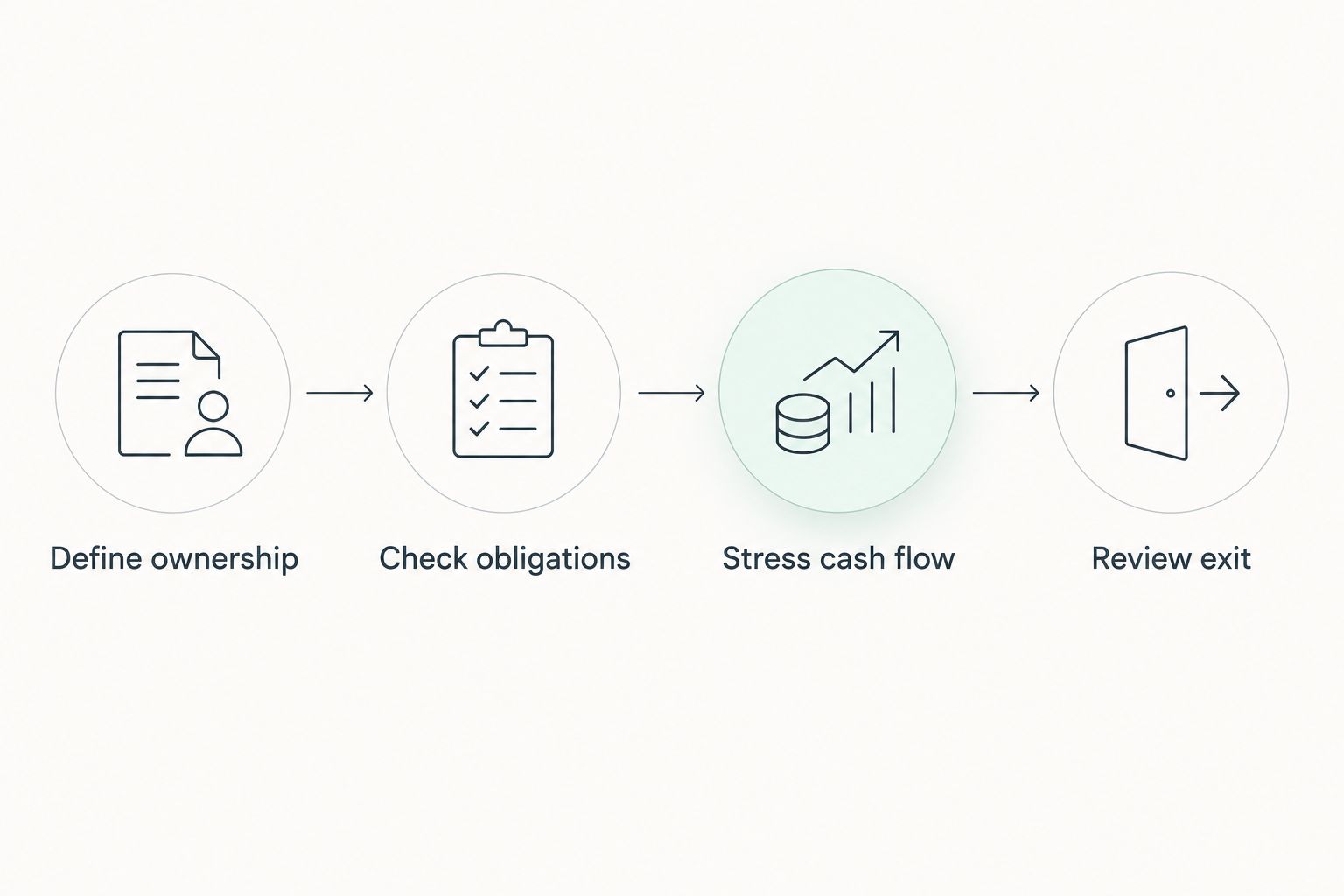
Four checks covering ownership, obligations, cash flow and exit terms

Check repayment capacity and exit terms before accepting the financing agreement.

Keep assumptions consistent across offers. Comparing one arrangement using strong sales and another using cautious sales tells you nothing useful about the financing itself.

Which equipment financing option should you choose?

Choose an equipment loan first when you want to own equipment for continuing use. Compare a lease when replacement is planned, and consider a line of credit only when equipment borrowing leaves sufficient operating capacity.

For equipment financing in Canada in 2026, use the 2M7 guide to choose the structure before comparing providers. Then compare written offers for the same equipment, funding need and intended use period.

If none of the offers survives your cash-flow checks, wait. Financing does not fix a purchase that your business cannot support.

FAQ

What’s the best equipment financing option in Canada?

An equipment loan is the default option for businesses seeking long-term ownership and scheduled repayment. A lease fits planned replacement better when its end-of-term conditions match the business’s needs.

Is an equipment loan better than a lease?

An equipment loan is better aligned with ownership; a lease is better aligned with use over an agreed term. Compare security, repayment obligations and exit conditions before choosing.

Can I buy equipment with a business line of credit?

You can use a business line of credit for equipment when the facility permits that use. Set a repayment plan and preserve enough capacity for operating expenses.

Does an equipment lease include maintenance?

An equipment lease includes maintenance only when the agreement explicitly provides it. Review responsibility for repairs, servicing, insurance and equipment downtime separately.

Is vendor financing a loan or a lease?

Vendor-arranged financing can involve a loan or lease, depending on the underlying agreement. Identify the actual financing provider and contract type before comparing the offer.

How much does equipment financing cost in Canada?

Equipment financing costs depend on the written offer, including financing charges, fees and required final obligations. Compare complete schedules for the same equipment and funding need rather than payments alone.

What should I check before signing an equipment financing agreement?

Check ownership, payment obligations, security, guarantees and exit conditions before signing. Test the agreement against expected trading, weaker revenue and an equipment interruption.

One last thing

The end of the agreement belongs in the beginning of your decision. Before accepting equipment financing in 2026, write down exactly what you must do to own, return, sell or replace the asset.

If you cannot explain that outcome in plain language, pause and get the relevant contract clause clarified. The final obligation matters as much as the first payment.

Read more