ClickCease

Best unsecured business loans in Canada 2026

Best unsecured business loans in Canada 2026

Best unsecured business loans in Canada 2026
15
Oct 2026
15
Oct 2026

Best overall for a defined expense: an unsecured term loan. Best for recurring cash flow gaps: an unsecured business line of credit. Best alternative to compare for revenue-based funding: 2M7, a direct funder offering merchant cash advances, not loans. This 2026 guide compares unsecured business loans in Canada with other funding structures, including where each option falls short.

TL;DR

  • Unsecured business loans suit defined expenses when scheduled payments fit your cash flow.
  • An unsecured business line of credit suits recurring working capital gaps, not permanent operating losses.
  • 2M7 offers merchant cash advances, not loans; confirm security requirements before treating an offer as unsecured.
  • Compare total repayment, personal guarantees and payment frequency before choosing business funding in Canada.

Why this matters

Unsecured does not mean the owner has no personal exposure. An unsecured business loan generally does not require specific collateral, but a lender can still require a personal guarantee. Read the actual agreement rather than relying on the product label.

That distinction matters when comparing offers in 2026. A loan, a revolving credit facility and a merchant cash advance have different structures. Choosing between them starts with what you need the money to do and how your business will meet the payment schedule.

This shortlist ranks funding structures by use case, not individual lenders by advertised claims. There is no universal winner: a facility that handles recurring inventory purchases is not automatically the right choice for a single equipment purchase.

What makes the best unsecured business loans?

Use these criteria before choosing a funding provider:

  • Purpose fit: Match a defined purchase to structured funding and recurring gaps to reusable credit.
  • Security requirements: Check for personal guarantees, security interests and claims against business assets.
  • Payment fit: Test the actual payment frequency against when customers pay you.
  • Total obligation: Compare the amount received, total repayment and all disclosed charges together.
  • Eligibility fit: Check operating history, revenue requirements and documentation before applying.
  • Exit terms: Understand early repayment, renewal and what happens after a missed payment.

For your 2026 comparison, use written offers rather than headline descriptions. Compare equivalent funding amounts and payment periods wherever possible. Otherwise, differences in structure can obscure what you are actually committing to repay.

Unsecured business funding options at a glance

Unsecured term loan

  • Best for: A defined expense with a repayment plan
  • Standout feature: A lump sum repaid over an agreed term
  • Key limitation: Scheduled payments continue when sales slow

Unsecured business line of credit

  • Best for: Recurring working capital gaps
  • Standout feature: Credit can be reused within the agreement's limit
  • Key limitation: Access remains subject to the facility's terms

2M7 merchant cash advance

  • Best for: Established revenue-generating businesses comparing loan alternatives
  • Standout feature: Direct funding with one fixed cost of capital disclosed before signing
  • Key limitation: Not a loan; security requirements need confirmation

Business credit card

  • Best for: Routine purchases accepted by card
  • Standout feature: Purchase-by-purchase access to revolving credit
  • Key limitation: A persistent carried balance creates an ongoing financing obligation

The merchant cash advance belongs here as an alternative, not as another name for an unsecured loan. Its inclusion does not establish that a particular offer is unsecured.

1. Unsecured term loan: best for a defined expense

An unsecured term loan provides a lump sum that you repay over an agreed period. It suits an expense with a clear purpose, such as a business improvement, when operating cash flow supports the scheduled payments.

Start with the expense, not the largest amount offered. Your repayment plan should identify where the payment comes from even if the purchase takes longer than expected to generate revenue.

Unsecured term loan pros:

  • A defined repayment period gives you an endpoint to plan around.
  • A scheduled payment creates a clear recurring cash commitment.
  • A lump sum supports an expense that must be paid upfront.

Unsecured term loan cons:

  • Scheduled payments do not disappear during slower trading periods.
  • A personal guarantee can create exposure beyond the business.
  • Early repayment terms differ between agreements.

Best for: A business with a defined expense and sufficient cash flow to support the proposed schedule.

Before accepting a 2026 offer, ask whether the payment can change, whether early repayment changes the total obligation and what triggers default. Obtain those answers in the agreement, not just in a conversation.

Verdict: Hold until the scheduled payment fits both normal and slower trading periods.

2. Unsecured business line of credit: best for recurring gaps

An unsecured business line of credit lets you draw funds within an approved limit and reuse credit as you repay, subject to the agreement. It suits timing gaps between business expenses and customer receipts.

The distinction is simple: a line of credit addresses a recurring timing problem, not an expense that permanently exceeds revenue. If the balance never comes down, examine the underlying cash flow problem before requesting more credit.

Unsecured business line of credit pros:

  • You can draw against the facility as a funding need arises.
  • Repayment restores access to credit within the agreement's terms.
  • Reusable credit matches repeated working capital needs.

Unsecured business line of credit cons:

  • The lender's agreement governs continued access and reviews.
  • Repeated drawings can conceal a persistent operating shortfall.
  • A personal guarantee can still be required.

Best for: A business with recurring, identifiable gaps between payments out and receipts in.

Ask what documentation the lender requires to maintain the facility. Also establish whether the lender can change the limit or demand repayment under specified circumstances. Available credit is useful only when you understand the conditions attached to it.

Verdict: Hold until you can explain how customer receipts will reduce each drawing.

3. 2M7 merchant cash advance: best for comparing loan alternatives

2M7 provides merchant cash advances and working capital directly to Canadian businesses. It is a direct funder, not a broker, and its product is not a loan.

2M7 is best for Canadian business owners comparing merchant cash advances with unsecured business loans. Its stated eligibility includes at least 3 months in business and $15,000 or more in monthly revenue, including businesses with less-than-perfect credit. Meeting those thresholds does not establish approval.

2M7 merchant cash advance pros:

  • You deal with a direct funder rather than a broker.
  • One fixed cost of capital is shown before signing.
  • The fixed cost does not change based on how long repayment takes.
  • Less-than-perfect credit is included in the stated customer profile.

2M7 merchant cash advance cons:

  • It is not suitable for a business specifically seeking a loan agreement.
  • The stated operating history and revenue thresholds exclude some applicants.
  • Flex payments apply only to businesses processing daily card payments.

Best for: A revenue-generating Canadian business evaluating working capital outside a conventional loan structure.

The published approval rate is 75%, not a promise of approval for an individual applicant. Before accepting an offer, confirm the payment mechanism, total repayment obligation, security requirements and any personal guarantee.

Do not assume a merchant cash advance is unsecured simply because it appears in a comparison of unsecured funding. The agreement determines the obligations.

Verdict: Hold until the written offer confirms that the structure and payment terms fit your business.

4. Business credit card: best for routine purchases

A business credit card provides revolving credit for purchases that merchants accept by card. It suits routine expenses when you have a clear plan to pay the statement balance.

A card is not interchangeable with working capital deposited into your business account. Check how the intended expense can be paid before choosing this route, especially for payroll or supplier obligations that do not accept card payments.

Business credit card pros:

  • You can fund individual purchases rather than draw a lump sum.
  • Statements create a record of card transactions.
  • Revolving credit can support recurring purchasing needs.

Business credit card cons:

  • Not every business expense can be paid by card.
  • Carrying a balance creates an ongoing financing obligation.
  • Personal guarantees and liability terms require review.

Best for: Routine card-eligible purchases supported by a specific repayment plan.

Read the terms for purchases, cash advances and missed payments separately. Those transactions can have different conditions. Do not treat the credit limit as a target spending amount.

Verdict: Skip for persistent cash shortfalls; hold for routine purchases until repayment is planned.

How these options were ranked

The ranking follows purpose fit, payment fit, security requirements, total obligation, eligibility and exit terms. A term loan comes first for a defined expense because the funding and repayment period can be matched to that expense. A line of credit takes the recurring-gap slot because it can be reused.

The merchant cash advance occupies a separate loan-alternative slot. A business credit card ranks for routine purchases rather than general funding needs. No provider receives a blanket recommendation based on an advertised approval rate or a product name.

How to compare written funding offers in 2026

Use the same review sequence for each offer. This keeps a clear application process from distracting you from an unsuitable agreement.

Funding purpose

Write down exactly what the funding will pay for. Separate a single purchase from a recurring operating gap, and distinguish delayed customer receipts from expenses that exceed revenue.

Payment fit

Place the proposed payments beside your expected customer receipts. Review both the amount and frequency. A payment that looks manageable in a monthly summary can still fall at the wrong point in your operating cycle.

Security terms

Ask for every personal guarantee and security provision to be identified. Confirm which party is responsible, what assets are involved and what happens if the business misses a payment.

Exit terms

Read the early repayment, renewal and default provisions before signing. Ask whether paying sooner changes what you owe and whether additional funding requires a new agreement.
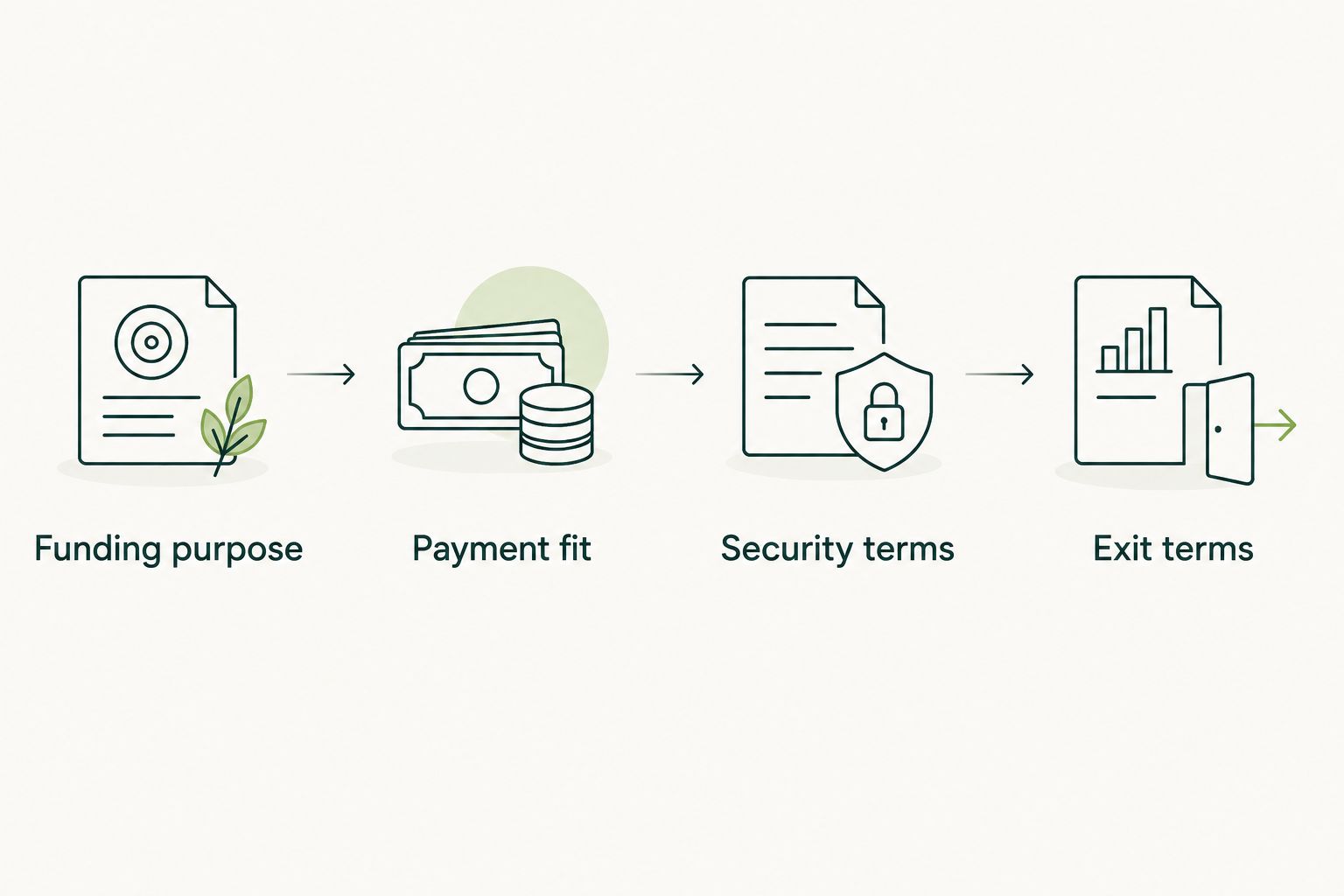
Four offer-review steps covering purpose, payments, security and exit terms.

Review the agreement's obligations before choosing the funding structure.

Keep the final offer and agreement together. If a verbal explanation differs from the documents, ask for clarification before accepting. The decision should rest on the terms you will actually sign.

Which unsecured business funding should you choose?

Choose an unsecured term loan as the default for a defined expense only when scheduled repayments fit your cash flow. Choose an unsecured business line of credit for recurring timing gaps that customer receipts will clear.

Compare a merchant cash advance when you want a loan alternative and understand its payment structure. Keep a business credit card for suitable purchases rather than treating it as a general solution to an ongoing operating deficit.

The deciding question in 2026 is not simply whether funding is unsecured. It is whether the written obligation fits the business that must meet it.

FAQ

What's the best unsecured business loan in Canada in 2026?

An unsecured term loan is the default option to compare for a defined expense with a clear repayment plan. An unsecured business line of credit is a better structural fit for recurring cash flow gaps, subject to the actual agreement.

Does unsecured business funding mean no personal guarantee?

No. An unsecured business loan can still require a personal guarantee, so review personal liability separately from collateral requirements.

Does 2M7 offer unsecured business loans?

2M7 offers merchant cash advances and working capital, not loans. Confirm security requirements and personal guarantee terms in the written offer rather than assuming the funding is unsecured.

Can a Canadian business with less-than-perfect credit apply for a merchant cash advance?

Yes, the stated customer profile for this merchant cash advance includes businesses with less-than-perfect credit. Eligibility also includes at least 3 months in operation and $15,000 or more in monthly revenue; approval is not assured.

Is a business line of credit better than a term loan?

A business line of credit is better suited to recurring timing gaps, while a term loan suits a defined expense. Compare the payment requirements and access conditions before choosing either structure.

Do merchant cash advance payments always change with sales?

No. Payment arrangements depend on the funding agreement, and flex payments under the merchant cash advance described here apply only to businesses processing daily card payments.

What should I ask before accepting unsecured business funding?

Ask about total repayment, payment frequency, personal guarantees, security provisions and early repayment terms. Make sure the written agreement answers each question before signing.

One last thing

Start with the payment calendar, not the approval message. Put every proposed funding payment beside payroll, supplier bills and expected customer receipts before accepting an offer. That exercise shows whether the funding solves a timing gap or adds another obligation at the wrong time.

Related guides

Related articles

August 13, 2026
August 13, 2026

How to Lose Less Money: Smart Habits for Cutting Business Costs

Most business owners think cost control means cutting corners. It doesn't. It means paying closer attention to where money actually goes and closing the gaps that quietly drain a business month after month. Every dollar you keep is a dollar you don't have to borrow, and every dollar you borrow at a high rate is a dollar working against you before it even hits your account.

Canadian small business owners are operating in a tighter environment than a few years ago. Supply costs have climbed, labour is more expensive to retain, and customers are pickier about where they spend. According to the Federal Reserve's Small Business Credit Survey, rising costs are the top financial challenge reported by small firms, cited by 75 percent of them, and more than half say they struggle just to cover operating expenses or manage uneven cash flow. That survey covers American firms, but the pattern holds true north of the border as well. Costs rise faster than owners expect, and the businesses that survive are the ones that build habits around watching them closely.

Know Your Real Break-Even Number

A lot of owners know their revenue targets but not their true break-even point once every fixed and variable cost is accounted for. If you don't know that number cold, you're guessing at pricing, guessing at how much slack you have in a slow month, and guessing at whether a new hire or piece of equipment actually pays for itself. Sit down quarterly, not annually, and recalculate it. Costs shift faster than most owners update their spreadsheets.

Audit Recurring Expenses Twice a Year

Subscriptions, software licenses, insurance policies, and vendor contracts have a way of renewing quietly at higher rates. A retail shop paying for three overlapping point-of-sale add-ons, or a trucking company carrying insurance riders it no longer needs, is losing money to inertia rather than necessity. Block time twice a year to go through every recurring charge and ask whether it's still earning its keep. Cancel what isn't, renegotiate what is.

‍

Watch Labour Costs Without Cutting Corners on Staff

Labour is usually the largest controllable cost for restaurants, retail, and construction and contracting businesses. The fix isn't fewer hands, it's better scheduling. Overstaffing during slow periods and scrambling during peak ones both cost money, just in different ways. Track hours against actual sales patterns rather than habit, and you'll usually find five to ten percent of labour spend that isn't tied to real demand.

Negotiate With Suppliers Like You Mean It

Too many owners accept the first price a supplier quotes and never revisit it. Long-standing vendor relationships are valuable, but loyalty shouldn't cost you money you don't have to spend. Ask for volume discounts, ask about early-payment terms, and get quotes from at least one competitor annually even if you have no intention of switching. Suppliers move on price when they know you're paying attention.

Fix Cash Flow Timing Before It Fixes You

A profitable business can still run into trouble if money comes in slower than it goes out. Research from the JPMorgan Chase Institute found that the median small business holds only 27 cash buffer days, meaning it could survive less than a month without incoming revenue. That's an American figure too, but the underlying lesson translates directly: most businesses are operating with almost no margin for a bad month, which is exactly why trimming avoidable costs matters as much as growing revenue.

Tighten invoicing timelines, follow up on late payments faster than feels comfortable, and consider deposits for larger jobs, something contractors in particular underuse. The goal isn't just profitability on paper, it's having cash on hand when a bill comes due.

Rethink How You Finance Growth

Cost control isn't only about spending less, it's also about borrowing smarter. A business with bad credit or thin financials often assumes a bank loan is the only option, then gets discouraged when the application drags on for weeks and still comes back denied. That delay itself is a cost. Time spent waiting on a bank is time a competitor spends serving your customers.

This is where alternative funding options like a merchant cash advance can outperform traditional small business loans, particularly for restaurant owners managing seasonal swings, retail operators needing inventory before a busy season, or trucking companies covering a maintenance bill that can't wait. Fast business funding based on your actual cash flow, rather than a rigid credit score cutoff, means you're not stuck choosing between missing an opportunity and taking on financing that doesn't fit your business.

Build a Habit, Not a One-Time Fix

The businesses that consistently lose less money aren't the ones that did one big cost-cutting exercise and called it done. They're the ones that treat expense review as a routine, the same way they treat inventory counts or payroll. Set a recurring calendar reminder. Assign someone  on your team to own it if you can't. Small, consistent attention beats a single dramatic overhaul every time.

Get the Right Financing Partner in Your Corner

Cutting costs only gets you so far if your financing structure is working against you. At 2M7, we've spent over a decade helping Canadian business owners, including those with bad credit, access merchant cash advances and fast business funding built around how their business actually earns money, not around a rigid checklist. Contact 2M7 today!

Read more
August 25, 2026
September 20, 2026

How Rising Interest Rates Are Changing Small Business Loans in Canada

A small business owner walking into a bank branch today faces a different conversation than the one their parents had ten years ago. Higher borrowing costs have changed how banks price risk, how much collateral they demand, and how quickly they say no. For owners who need capital to make payroll, restock inventory, or replace a piece of equipment that just quit on them, that shift matters more than any headline number on a rate announcement.

The Bank of Canada's Rate Path and What It Did to Lending

When the Bank of Canada raised its policy rate aggressively starting in 2022, the intent was to cool inflation. It worked, but it also raised the cost of every variable rate loan, line of credit, and floating mortgage tied to prime. Banks didn't just pass along higher rates. They also tightened who qualifies for credit in the first place, because higher rates raise the odds of default across their loan books, and lenders respond to that risk by pulling back.

According to the Bank of Canada, cited in ISED's biannual survey analysis, borrowers themselves reported a tightening in overall business lending conditions, a signal that came directly from the Senior Loan Officer Survey rather than from lenders describing their own policies. That distinction matters. It means the businesses on the receiving end of these decisions noticed the change before it showed up in any official policy statement.

Fewer Businesses Are Even Bothering to Ask

One of the more telling shifts isn't in approval rates. It's in how many owners apply for debt financing at all. According to ISED, debt financing requests from small businesses fell to their lowest share since 2009 in 2024. That's not a sign that businesses stopped needing capital. It's a sign that more owners looked at bank criteria, decided they wouldn't qualify or couldn't stomach the terms, and didn't bother filing an application that would just get declined.

That quiet withdrawal from traditional lending channels is where alternative financing has stepped in.

‍

‍

Why Banks Have Gotten Harder to Work With

Traditional lenders operate on thin margins and heavy regulatory oversight. When rates rise, three things happen inside a bank's underwriting process that owners rarely see directly.

First, debt service coverage requirements get stricter. A business that could comfortably cover its loan payments at a five percent rate might not clear the bar at eight percent, even if revenue hasn't changed at all. Second, banks lean harder on personal guarantees, collateral, and time in business, which locks out newer companies and anyone without significant fixed assets. Third, approval timelines stretch out, sometimes to six or eight weeks, because underwriters are doing more manual review on files that would have sailed through a few years ago.

None of this means banks are wrong to tighten up. It means the businesses that most need fast capital, seasonal operators, contractors waiting on invoices, retailers restocking ahead of a busy season, are the ones least equipped to survive a slow, restrictive process.

Where Owners Are Turning Instead

Alternative lending exists because it solves a timing problem banks are structurally bad at solving. A merchant cash advance, for instance, is underwritten against a business's actual sales history rather than a credit score alone, which means approval can happen in days instead of weeks. For businesses with inconsistent monthly revenue, that structure often fits the real cash flow pattern of the business better than a fixed loan payment does.

This shows up clearly in specific sectors. Restaurants running on tight margins can't wait two months for a bank decision when a walk-in cooler dies in July. Construction and trade businesses face a similar mismatch, since they're often paid on net-30 or net-60 terms while still needing to cover payroll and materials in real time.

Retailers face their own version of the problem heading into peak seasons, when inventory has to be purchased well before it turns into revenue. Waiting on a bank line of credit renewal during that window can mean missing the season entirely.

Credit History Isn't the Dealbreaker It Used To Be

Banks weight personal and business credit scores heavily, and a few rough years, common for anyone who ran a business through 2020 and the years that followed, can shut the door on conventional financing for good. Alternative lenders generally look at current business performance instead of past credit events. If bad credit has been an issue, that doesn't have to be the end of the conversation the way it often is at a branch.

Fast Business Funding as a Strategic Tool, Not a Last Resort

There's a persistent myth that alternative financing is what businesses turn to when they've been rejected everywhere else. That's outdated. Owners increasingly choose fast business funding deliberately, because speed itself has value. A contractor who can jump on a bulk materials discount, or a retailer who can restock a bestseller before a competitor does, is using capital as a competitive weapon, not a rescue line.

Small business loans through traditional channels still make sense for long-term, predictable financing needs, equipment with a long useful life, real estate, expansion with a clear payback horizon. But for working capital, bridging receivables, or reacting to an opportunity that won't wait for a loan committee, alternative structures like a merchant cash advance are frequently the better fit regardless of what a business's credit profile looks like.

Rates will eventually come down from where they've been, but the underwriting discipline banks have built during this tightening cycle isn't likely to disappear overnight. Lenders that got burned by looser standards in the past don't unwind those lessons quickly. Owners who build a relationship with alternative funding sources now, before they're in a cash crunch, put themselves in a stronger position regardless of where the next rate decision lands.

The businesses that come out ahead in this environment aren't necessarily the ones with the best credit scores. They're the ones that understand which type of capital fits which type of need, and who don't wait until a bank says no to look at their other options.

Talk To Us

If bank timelines and tightening criteria are getting in the way of decisions your business needs to make now, don’t hesitate to contact us. We work with Canadian small businesses across restaurants, construction, trucking, and retail to structure funding that matches how your revenue actually moves.

‍

Read more
May 11, 2026
May 13, 2026

What Is a Merchant Cash Advance?

A Smarter Way for Canadian Small Businesses to Manage Cash Flow

‍

Running a small business in Canada is one of the most rewarding things a person can do. It is also one of the most financially demanding. You have likely experienced the particular tension of knowing your business is performing well on paper while watching your bank account tell a different story. A major client is 60 days past due. A seasonal lull has arrived ahead of schedule. A supplier is offering a bulk discount that expires before your next revenue cycle closes.

This is the cash gap, and it has nothing to do with how well you run your business. It is simply the reality of operating in an economy built on delayed payments, unpredictable demand, and tight margins. For restaurant owners managing weekend rushes and mid-week lulls, for contractors waiting on draws from general contractors, for retailers carrying seasonal inventory before sales materialize, this gap is not a sign of failure. It is a structural challenge that every business owner eventually confronts.

The question is not whether the gap will appear. The question is what tool you reach for when it does.

‍

Proactive Capital vs. Reactive Borrowing

There is a meaningful difference between borrowing out of desperation and borrowing as a deliberate business strategy. Most business owners have experienced the former: scrambling to cover payroll, negotiating with suppliers, or dipping into personal savings to keep operations moving. That kind of reactive borrowing is stressful, often expensive, and tends to happen at the worst possible time.

Proactive capital is different. It means having access to funds before the emergency arrives, using financing to take advantage of opportunities rather than to avoid collapse. It might look like purchasing inventory at a bulk discount, hiring a key employee ahead of a growth period, or bridging a gap between two large contracts so your team stays intact and your momentum stays strong.

This is where fast working capital becomes a genuine asset. When a business owner understands their financing options before they need them, they can move quickly and with confidence. They become the kind of operator who says yes to opportunity rather than the kind who watches it pass.

‍

How a Merchant Cash Advance Actually Works

Most introductions to merchant cash advances cover the basics: a lender provides a lump sum of capital, and repayment comes through a percentage of your daily credit and debit card sales. That structure is accurate, but it undersells one of the most important features of this product.

An MCA functions as a fluctuating safety net. Because repayments are tied directly to your daily sales volume, your payment obligations contract automatically when business slows down. During a quiet January, a restaurant remits less. During a slow construction season, a contractor's burden eases. When volume picks back up, repayments adjust accordingly. There is no fixed monthly payment sitting on your books demanding the same amount whether you had a record week or a difficult one.

This is fundamentally different from a term loan, where a fixed payment comes out regardless of how business is going. For industries with natural revenue cycles, that rigidity can be genuinely dangerous. The flexible structure of merchant cash advances removes that rigidity, replacing it with a repayment rhythm that breathes alongside your business.

The approval process is also designed with the realities of small business in mind. Where a traditional bank will scrutinize years of financial statements, credit scores, and collateral, an MCA provider focuses on your actual sales history. Your revenue tells the story that matters.

‍

Strategic Use Cases: When an MCA Makes the Most Sense

There are specific situations where a merchant cash advance is clearly the better tool compared to a conventional bank loan. Here are the scenarios where business owners consistently find it valuable:

  • Seasonal inventory purchasing, where a retailer needs capital in October to stock for December but won't see revenue for six to eight weeks.
  • Emergency equipment repair, when a piece of critical machinery fails and a multi-week bank approval process would mean lost contracts and idle staff.
  • Bridging large contract gaps, particularly in construction and trades, where work is completed in one period but payment arrives weeks or months later.
  • Capitalizing on a time-sensitive supplier discount that requires immediate payment and delivers significant long-term savings.
  • Hiring and onboarding ahead of a known busy season, so the business is staffed and ready rather than scrambling mid-rush.

In each of these cases, speed and flexibility matter more than the cost comparison to a conventional loan. The opportunity cost of waiting is higher than the cost of the capital itself.

How Industry-Specific Businesses Use This Tool

In construction, the cash flow problem is almost universal. Materials need to be purchased, subcontractors need to be paid, and equipment needs to be maintained long before a draw schedule releases the next tranche of project funding. A merchant cash advance bridges that gap without requiring the collateral or credit profile that banks demand. Especially for construction companies, this kind of flexible capital is often the difference between taking on the next contract and turning it down.

In retail and food service, the challenges are different but equally real. Inventory decisions get made months in advance. Staffing ramps up before revenue does. A single slow season can destabilize months of careful planning. Having a capital partner who understands these cycles, and whose product is structured to accommodate them, changes how a business owner approaches their planning.

A Partnership Built for Resilience

2M7 is not simply a transaction. The goal is to function as a genuine partner in the financial health of your business, providing tools that help you maintain stability when the market becomes unpredictable and capture growth when the window opens.

Canadian small businesses deserve access to capital that was actually designed for the way they operate, not the way a spreadsheet imagines they operate. A merchant cash advance, used strategically and with clear intent, can be that tool.

Ready to Close Your Cash Gap?

If you are navigating a cash flow challenge or preparing for a growth opportunity and want to understand what funding might look like for your specific situation, the 2M7 team is ready to have that conversation. Reach out directly and speak with someone who understands the pressures you are managing.

‍

‍

Read more